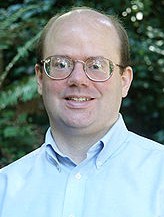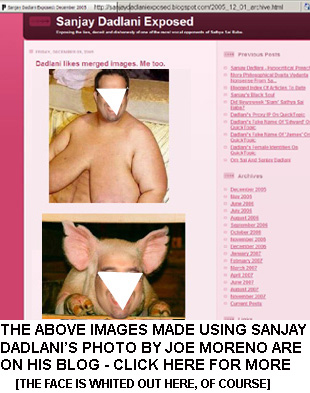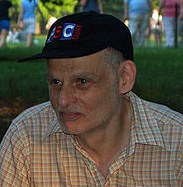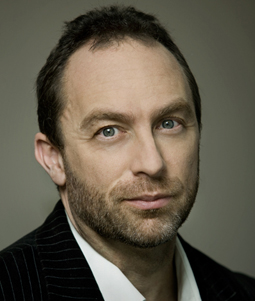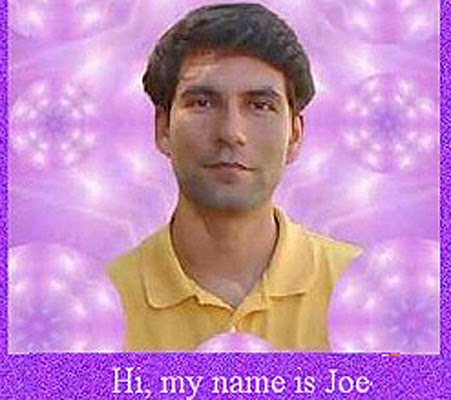
SSS108, alias Gerald Joe Moreno (d.2010). The only known image of Moreno, from his own file.
This webpage covers various dimensions of an Article Deletion on Wikipedia, an event viewed as a triumph for the religious "cult" affinities known to exist in that disputed project. The underlying problem originated in a Wikipedia User page of 2006, created by a Sathya Sai Baba activist. Cyberstalker activity developed to an extensive degree, influencing Wikipedia personnel. A continuing drawback was the inability of a markedly aggressive Wikipedia editorship to duly distinguish between tangibly different persons (section 11 below). The offensive User page of SSS108 (Gerald Joe Moreno) was deleted from Wikipedia in February 2012 by Jimmy Wales (section 13 below).
SSS108, alias Gerald Joe Moreno (d.2010). The only known image of Moreno, from his own file. |
CONTENTS KEY
Short Read Statement of Content
6. Arguments For and Against Article Deletion
7. Wikipedia Exegesis of Simon Kidd
8. "If in doubt as to whether there is consensus to delete a page..."
9. Hate Campaign Blogs of Gerald Joe Moreno
10. Harassment Tactics on Wikipedia
11. Triple Incarnation Theory, or hazard for real name writers
13. Jimbo Deletes SSS108 User Page
Short Read Statement of Content
Some would-be readers have complained that this article is in the long read category. They want a short statement of content to assist assimilation. I will here attempt to oblige in a single paragraph:
I am an Irish-English citizen author of working class background. I am half-Irish, half-English. In 2009, a British author was kind enough to provide a Wikipedia article about me. An academic editor, of Irish origin, generously approved the entry and recommended a good article listing in Wikipedia terminology. I think that the real name Wikipedia editor was suggesting, via this recourse, that studious citizens may qualify for listing on Wikipedia along with status academics, novelists, and entertainers. His liberal suggestion was repudiated by American supporters of Ken Wilber, Stanislav Grof, and Adi Da Samraj. A Grof supporter had already tried to remove my name from Wikipedia on a 2006 talk page; the censorship can act as a warning to outsiders from a psychedelic cult. Partisan association with Bhagwan Shree Rajneesh also figured in the new opposition of 2009 from pseudonymous editors. In addition, a very resistant American academic devotee of Meher Baba employed against me hostile and libellous blogs of an American partisan of Sathya Sai Baba (a former editor who had been banned from Wikipedia for aggressive behaviour). The Kevin R. D. Shepherd article was deleted on contested grounds of notability. Subsequently, a British academic administrator mistakenly associated my books with the output of an American publisher committed to a “new spirituality” agenda. This overbearing British gesture supposedly proved that my books were not sufficiently notable for reference on Wikipedia. I have recorded below a number of attendant details that might otherwise be forgotten. I make no claim of being notable. I come from low status citizenry (Irish peasantry, Irish Scots, and English working class). I am content with that pedigree, please note.
This article furnishes support for the critical view of Wikipedia as being influenced by sectarian interests. That drawback is a consequence of the pseudonymous "anyone can edit" policy. See also Wikipedia Misinformation.
By 2008, it became well known on the web that Wikipedia had a cult problem. The Conflict of Interest Noticeboard was created by Jossi Fresco, a prominent administrator (using his real name) who became notorious as a cult sympathiser. Jossi Fresco openly acknowledged that he was employed by an organisation related to Prem Rawat, a guru of whom he was a long-term student. The guru was formerly known as Guru Maharaj Ji, and encouraged devotees to call him “Lord of the Universe.” He was leader of the Divine Light Mission, which gained enthusiastic support in the 1970s.
An ex-devotee of Prem Rawat reported that Jossi Fresco had been one of the guru’s close staff members, creating the guru’s first website. A major discrepancy was observed. Fresco denied any Conflict of Interest (COI), even while contributing to articles about his guru on Wikipedia. See Cade Metz, Wikipedia ruled by ‘Lord of the Universe’ (February 2008). Fresco claimed to be observing a neutral point of view (NPOV). Neutrality is said to be contradicted by COI, according to Wikipedia canons. As a consequence, the ubiquitous terms COI and NPOV became regarded by critics as meaningless slogans created by the Wikipedia hierarchy.
Jossi Fresco on his Wikipedia page |
The influence of Jossi Fresco was said to be pervasive on Wikipedia. He was detested by some observers for removing a clause that prohibited followers of gurus to edit articles about their figurehead. He denied having the power to influence Wikipedia rules and regulations. Jossi Fresco was sarcastically referred to as one of the “inner circle” in the Wikipedia project. He was reported to maintain strict control over the Prem Rawat article and numerous related articles. It is also said that he did his best to influence articles about other gurus. He restricted criticism of his own guru to the point where there was almost no criticism.
On his Wikipedia User page, Jossi Fresco described himself as a “renaissance man.” A less flattering description from some critics was that of “cultist.” The accusation is that he fostered a mood of indulgence amongst Wikipedia editors about sects and cults (too often identical according to sceptical analysts).
The COI guidelines were drafted in October 2006. Shortly afterwards, Jossi Fresco removed a section of the protocol which prohibited followers of gurus from editing articles about the latter. Subsequently, “the latest Wikievidence against Fresco was posted after he attempted to intervene in a Wikicourt trial involving the Church of Scientology.” This episode involved the disconcerting fact that “several pro-Scientology accounts have been editing the site using Scientology-owned computers.” Fresco subsequently exited from Wikipedia. See Cade Metz, Jossi Fresco Retires from Wikipedia (January 2009).
Larry Sanger |
In February 2008, a critical statement was made by Larry Sanger, founder of the rival web encyclopaedia called Citizendium. This was in relation to Jossi Fresco, who had posted contributions on that more disciplined site. Sanger commented:
Since in the opinion of some, Prem Rawat is the head of a ‘cult,’ and as cult leaders frequently have idiosyncratic ‘takes’ on common topics (to put it nicely), I think we should doublecheck the information in all of these articles. Larry Sanger, Prem Rawat & Jossi Fresco (2008).
A subsequent outspoken article on The Register website asserted that "the inner circle [of Wikipedia] is a cult." This deployment of the word "cult" departs from my own usage in the religious context; political dimensions of the word "cult" are not the concern here. My point is that sectarian or religious "cult" sympathisers can gain a strong hand on Wikipedia when this is not always too obvious. Cf. Cade Metz, A Great Wikipedian (March 2008). This article attacked the Wikipedia figurehead Jimmy Wales, instead supporting his rival Larry Sanger, who is here reported to have taken away the editing rights of Jossi Fresco on Citizendium, with the consequence that "Fresco promptly left the project."
When I first took notice of Wikipedia in 2006, I was not a computer user. Friends gave me some articles and magazine coverages; I was impressed with the concept of a citizen encyclopaedia. That was a fairly general reaction. The concept seemed very progressive, and yet there were rumours about mishaps and disagreements, most of all between Jimmy Wales and Larry Sanger. These two were the original creators of the project; the academic Sanger soon retreated in disillusionment and established a rival.
In the autumn of 2006, a friend supplied me with a print-out of a recent Wikipedia User page that attacked and stigmatised my publishing project Citizen Initiative. At first I could not believe this document. The User page was dated October 2006, and bore the title User:SSS108/Kevin Shepherd. The page comprised a dialogue between four Wikipedia editors, one of whom was SSS108, and obviously the major player. I had no idea who this attacker was. The dialogue also featured an entity called Jossi, whom I later learned was the administrator Jossi Fresco. Jossi was here a support act, clearly in sympathy with the argument of SSS108. Only one of the participants (Andries) was sympathetic to myself. Andries argued strongly against SSS108, though eventually saying that he would re-consider his opinion. I later learned that Andries was an ex-devotee of the guru promoted by SSS108. The guru was Sathya Sai Baba (d.2011). SSS108 was a partisan editor of the Sathya Sai Baba article on Wikipedia.
The dialogue on the SSS108 User page was preoccupied with a theme relating to the Sathya Sai Baba article. A brief editorial quote was the bone of contention, referring to an appendice in my book Investigating the Sai Baba Movement (2005), where I had covered views of ex-devotee Robert Priddy. The quote was rejected by SSS108, who was supported by Jossi. Priddy, the retired academic of Oslo University, was evidently detested by SSS108 for being a critic of Sathya Sai Baba. I grasped that because I had mentioned Priddy favourably, I was now being censured. This was Wikipedia, the new forum for perfect neutrality.
My project Citizen Initiative was dismissed by SSS108 as a self-publishing aberration of no consequence. The implication was that my book, mentioning Priddy in an appendice, was useless and unfit to read. No other part of that book was represented. This was clearly a sectarian strategy, and one permitted by the administrative auspices of Jossi Fresco, at the time when the latter acquired maximum influence in Wikipedia. See further Rick Ross Complains about Jossi Fresco on Wikipedia (2008).
Subsequently, an academic friend of mine discovered the identity of SSS108. He was Gerald Joe Moreno of New Mexico, of whom I had never before heard. He had the reputation of being an obsessive defender of Sathya Sai Baba. Confusingly, he claimed not to be a devotee. Moreno’s apologist web campaign attacked all critics of his guru, denouncing them on principle, using pet formulae of disapproval. The critics were depicted as liars, perverts, and aberrant sources of information. Moreno’s acute opposition to Robert Priddy on Wikipedia caused widespread puzzlement and misconceptions. Many observers found difficulty in understanding what was happening. Events were subsequently recorded. See Ex-devotee Robert Priddy (2009).
Eventually Moreno annoyed a number of other editors. He was banned indefinitely (along with two others) in March 2007 by an Arbitration Committee. See Requests for arbitration. Mel Etitis accused Moreno of being "aggressive, abusive, and confrontational," further saying that he had to block Moreno for "harassment and incivility." Moreno accused Etitis of being involved in a "sockpuppet cover-up," a theme subsequently expressed in a blog. The Arbitration Committee concluded that Moreno was engaged in "activist editing," being the webmaster of several attack sites and blogs in the cause of Sathya Sai Baba. The arbitration report carries the emphasis: "Wikipedia is not a soapbox for propaganda or activist editing."
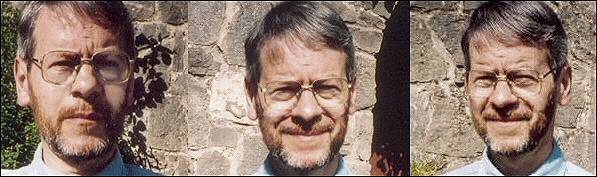
Images of Kevin R. D. Shepherd, 2004. Copyright Kevin R. D. Shepherd. This triple image of a victim was contrived by Gerald Joe Moreno, alias SSS108, the cyberstalker who commenced his attack from Wikipedia. The triple image appeared on the sectarian attack website saisathyasai.com in 2007, appropriating images from separate pages at my Citizen Initiative website, and appending a libellous text. Moreno also routinely reproduced this triple image on notorious hate campaign attack blogs at blogspot.com. Nobody needs three images to identify a subject; the excess is symptomatic of sectarian cyberstalker tactic. The accompanying attack blogs were used against me on the Wikipedia AfD page discussed below, a development innovated by an American Meher Baba devotee. See further Internet Terrorist and Wikipedia, Moreno, Google. Also Wikipedia Anomalies: Sequel and Not Exposed. |
In July 2007, Gerald Joe Moreno adapted part of his User page to a blog entitled Kevin Shepherd and Robert Priddy. Moreno here called himself Equalizer, one of his favoured pseudonyms. Again there was dismissal of my books, clearly influenced by the association of my nine-page appendice with his arch-opponent in Norway. The entries of Moreno on Google Search were typically pseudonymous (e.g., Equalizer), often exhibiting caustic descriptions of his victims on Search page captions.
A misleading sectarian jibe that Moreno frequently employed against me was “vanity self-publisher,” an epithet designed to afflict my career status and to prove that I was not worthy of serious consideration. He also invented the theme that I endorsed/defended a "psychic trance medium," namely ex-devotee Conny Larsson. In reality, I have never endorsed Larsson, but merely quoted from a talk he gave at a FECRIS conference in 2006 about his former guru Sathya Sai Baba. See Allegations of Sexual Abuse (2008). I do not defend Larsson, who is a “workshop” figure professing exotic abilities about which I am sceptical. I have actually described him under the heading of New Age Confusions (2009). Larsson promoted the “Vedicmasterclass,” which led to accusations of “channelling,” though he denied this. Ex-devotees have sometimes been confused after transiting from their former hero-worship of the guru they discovered to be a sexual abuser.
In his very exaggerated manner, Gerald Joe Moreno even claimed that I was a “New Age promoter” on the basis of citing Larsson’s FECRIS report concerning the sexual abuse activities of Sathya Sai Baba. There are pronounced errors in sectarian attack blogs. Allegations of sexual abuse were adamantly denied at every turn by the apologist, who presented victims of abuse, and critics of abuse, as deviants and villains undeserving of attention.
Moreno was considered by one academic contact of mine to be crazed, the obsessive factor of attack having gone too far. Others described him as an opportunist in building up a web network of attack blogs and sites that made him popular with uncritical devotees of his guru. Some ex-devotees of Sathya Sai were inclined to believe that Moreno was paid for his extensive web activity (apparently full-time) by a wealthy devotee, possibly Dr. Michael Goldstein of California, the official leader of the Sathya Sai Baba Organisation. Moreno became notorious for defamation, and was regarded by ex-devotees as a cyberstalker. He falsely accused an ex-devotee (Barry Pittard) of being a paedophile. The details have been considered revealing of sectarian excess. See Defamation of Barry Pittard (2008). See also section 9 below.
When Jossi Fresco left Wikipedia, many Wikipedians apparently believed that everything was now on even keel. However, the ongoing jargon of NPOV, COI, “original research,” and other themes was regarded with scepticism by some observers. The obsolete Wikipedia User page of SSS108 (Joe Moreno) remained high on my Google Search name list. There seemed to be nothing I could do about this unless I resorted to an expensive lawsuit. Some persons were confused by Moreno web strategies, others were nauseated by his output. Gerald Joe Moreno (d.2010) maintained a series of attack blogs at blogspot.com, and eventually included me in that ominous cycle of defamation and distortion. My objection to libel was treated as a threat to his sectarian campaign.
2. Criticisms of Wikipedia
I have never been a Wikipedia editor, and have no wish to be one. Another relevant point is that, in 2007, and shortly after becoming a computer user, I mentioned in a web entry that I had declined the offer of an article about myself on Wikipedia. I expressed strong reservations about the Wikipedia format, but added that I would await developments in future policy. I was too distrustful of the editing procedures involved. I had heard about the “edit wars” and related problems that can occur on Wikipedia talk pages. There were also reports of attempted lawsuits against Wikipedia by discontented article subjects. University academics in general had formed a low opinion of Wikipedia articles; some professors were said to be resistant on principle to citing Wikipedia. Taken together, all these details left me feeling disconcerted by the online encyclopaedia.
Most of the volunteer Wikipedia editors still exhibit pseudonyms. The American fashion for web pseudonyms soon percolated to other countries. Some observers refer to this trend in terms of a retrogression from standard educational media.
There have been many other complaints. Wikipedia mentioned a number of these in the article Criticism of Wikipedia, including the observation: "Wikipedia's notability guidelines, and the application thereof, are the subject of much criticism" (accessed March 2010). A related article Reliability of Wikipedia included information about an editor of Encyclopaedia Britannica, who commented that the Wikipedia article on the British soap opera Coronation Street was twice as long as the article on Prime Minister Tony Blair. Co-founder Larry Sanger is reported as stating in 2004: "When it comes to relatively specialised topics (outside of the interests of most of the contributors), the project's credibility is very uneven" (accessed 18/03/2010). See also my Wikipedia Issues.
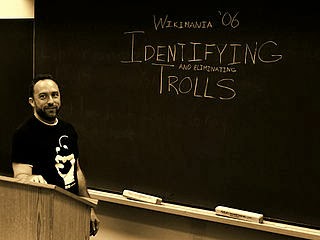
Jimmy Wales and a Wikipedia problem |
In 2008, a strong list of complaints appeared in a well known internet feature entitled Criticisms of Wikipedia. The accusation was there made: "Wikipedia's 'anyone can edit' culture has allowed baseless defamation of various individuals to spread widely through the Internet." Irresponsible pseudonymous editors were not the only target of disapproval. "Wikipedia's administrators have become an entrenched and over-powerful elite, unresponsive and harmful to authors and contributors." The scalding reflection emerged that "administrative abuse is the norm, rather than the exception," with the additional drawback of "no process by which administrators are reviewed regularly for misbehaviour."
Even by that early date, numerous problems were evident in the pseudonymous web milieu. A well known reflection stated:
Wikipedia editors may contribute as IP addresses, or as an ever-changing set of pseudonyms. There is thus no way of determining conflicts of interest, canvassing, or other misbehaviour in article editing. Wikipedia's administrators are similarly anonymous, shielding them from scrutiny for their actions. They additionally can hide the history of their editing (or that of others).... Wikipedia over-emphasises popular culture and under-emphasises scholarly disciplines. Wikipedia contains more articles, of greater depth, on television shows, toy and cartoon characters, and other ephemera of popular culture than on many prominent historical figures, events, and places. Massive effort is spent on documenting fictional places and characters rather than science, history, and literature.
Many thousands of editors have contributed to the project. However, in 2010 only about 900 contributors were administrators, a role including the option to delete articles. Thousands of articles are deleted every year, sometimes in circumstances of disagreement. The criterion of notability has a repute for being arbitrary. Such exploitive films as A Clockwork Orange have been deemed notable, at the expense of deleted non-movie subjects of a far less socially violatory nature.
The project has been criticised for tending to depreciate serious research work, and for favouring popular culture in such forms as cinema and music. One accusation is that articles like Egg and chips do not provide a sufficient standard of education. The article Egg and chips informs, for instance, that this dish was John Lennon's favourite food, and that his Aunt Mimi would prepare it for him with a cup of tea (accessed 22/02/2019). Critics ask: what real use is there in such information?
Criticism of Wikipedia has mounted in recent years. For instance, in 2011, the reliability of Wikipedia articles was reported to be "well short of the standards for a school paper." The critic gave reasons why "students cannot cite or rely on Wikipedia," including the caveat that very few Wikipedia contributors use their real name. The same web article cited a Wikipedia verdict: "While some articles are of the highest quality of scholarship, others are admittedly complete rubbish."
In 2013, the MIT Technology Review conveyed an article called The Decline of Wikipedia. The author states that the sixth most widely used website in the world was in trouble. The volunteer workforce of Wikipedia had "shrunk by more than a third since 2007 and is still shrinking; those participants left seem incapable of fixing the flaws that keep Wikipedia from becoming a high quality encyclopaedia by any standard, including the project's own." The same writer refers to 1,000 articles that Wikipedia personnel have described as forming the core of a good encyclopaedia. Yet most of those entries do not "earn even Wikipedia's own middle-ranking quality scores." Tom Simonite also refers to "a crushing bureaucracy with an often abrasive atmosphere that deters newcomers" who might broaden the coverage. See also Rise and Decline, which charts a contraction from over 50,000 to over 30,000 editors between 2007-2012 (in the English language version).
The website Wikipediocracy commenced in 2012, being notably critical of the Wikipedia editorship and administration. The contributors include Wikipedia personnel. A major emphasis on this site is that "you can't talk about Wikipedia's flaws on Wikipedia." One contributor relays: "Wikipedia is a chaotic place, notorious for its abuse of outsiders and intolerance of open criticism." A declared aim of this critique is:
to innoculate the unsuspecting public against the torrent of misinformation, defamation, and general nonsense that issues forth from one of the world's most frequently visited websites.
On the misleading myth that Wikipedia is as accurate as Britannica, Wikipedian Andreas Kolbe has informed: "Wikipedia contains hoaxes and vandalism. It contains malicious defamation and anonymous hatchet jobs authored by people who are in conflict with the person they are writing about, or simply jealous of their success." There is also the scenario of alienated academics in conflict with young editors possessing only a superficial understanding of subjects at issue. Many Wikipedia editors are estimated to be in their twenties and teens. There is also the hazard of "arcane and self-contradictory policies and guidelines" that influence Wikipedia.
A strong critic transpired to be Professor Carl Hewitt, an expert in computer science at MIT. He was banned from Wikipedia in 2007, allegedly because of "self-promotion." His well known online report cited the accusation: "Wikipedia resembles the Third Reich rather than a free media." His report also complained at the censorship by administrators, the lack of accountability, and disrespect for expertise. See also Wikipedia Flaws, mentioning a verdict expressed as: "The criteria of 'notability' and 'neutral point of view' and 'verifiability' for such [Wikipedia] articles are almost meaningless."
A particular concern has been the age of some administrators. Wikipedian "insider" information has revealed that "many Wikipedia administrators are school-going teenagers." This means that the guiding milieu is often one of schoolchildren and college students. There are frequent sceptical reactions to this situation. An instance is on record where an eleven year old boy became an administrator; at the age of twelve, he gained the right to appoint other editors to the rank of administrator.
Wikipedia is sometimes described as "crowdsourced." The project has been compared unfavourably with the Stanford Encyclopaedia of Philosophy, another free online facility. In that direction, one commentary remarks: "Except perhaps in a few areas in which enough well-informed people care for errors to get weeded out, Wikipedia is not authoritative" (What Wikipedia can only dream of).
3. GA (Good Article) Listing
A fairly long article appeared on Wikipedia about the present writer in 2009. I relented in my opposition to such a feature in view of, e.g., the fact that cult influence was regarded by some as being on the wane after the exit of Jossi Fresco. The article was subsequently deleted in circumstances of disagreement. The declared issue was notability. I do not claim notability, being only a citizen thinker and independent analyst. There were other, and closely accompanying, aspects of the deletion process which pose questions for the Wikipedia system, and which are on record. In what follows I will attempt a summary of those matters.
Stephen Castro |
A new British editor, Alex Jamieson (real name Stephen Castro), posted the Wikipedia article on myself in September 2009. He had grasped that I was sceptical of Wikipedia, and so before posting, he mentioned his article to me. I had not seen him for over six years. Jamieson had not formerly agreed with all my views, but I did not object to his good intention. He said he had now come to believe that my general perspective was valid. Jamieson had written three appreciative reviews of my books on Amazon, as if to prove his point. He was enthusiastic about theories of the neomaterialist anthropologist Marvin Harris, whom I viewed more critically. He had recently made a study of Roger Sperry, and was prepared to credit my “philosophy of mind” extension of that neuroscientist. Jamieson had read all my books, which he had in his possession.
After his article Kevin R. D. Shepherd had been made available online, Jamieson asked my permission to reproduce an image of myself. I consented, being of the opinion that his article was a fair representation of the subject, and quite unlike the earlier hostile User page of SSS108 (Gerald Joe Moreno) dating to 2006. Jamieson misunderstood the copyright factor, and stated that he was the copyright holder. The image was already copyrighted in my name, and still is.
Another Wikipedian took an interest in the article under discussion. This was Simon Kidd, an unusual editor who uses his real name. He had a master’s degree in philosophy, and stated that he had been reading my books for many years. I have never met him. He comes from Dublin, but now lives in Australia. I was surprised when he decided to confer GA or “good article” listing on the entry about myself by Jamieson. Such listing has a rather elite status, and I was uncertain about all the significations.
On November 6th, 2009, a hostile editor named Jayen466 posted an objection to the article. There was a reference to “the possibility of COI and/or sockpuppeting.” It was discovered that Jayen466 was strongly associated with sectarian interests, having appeared on the Sathya Sai Baba page and the Prem Rawat page. His tone was very accusing. His real identity was unknown. He was contesting GA status for the article, and implying infringements that reflected adversely on both Jamieson and Kidd.
Sockpuppeting is an ubiqitous theme on Wikipedia, with frequent militancy on that score. The problem is basically caused by the prevalent anonymity on Wikipedia. The accusation is too often groundless. Some readers get tired of the phraseology employed.
On Nov. 9th, Jayen466 (or JN466) also aggravated on Wikipedia about a link on my website to the article on myself. “The subject’s website carries a prominent link to this article, even though the article is quite recent.” This struck various observers as a ludicrous accusation. The Wikipedia article on myself had been visible online for two months by that time, giving ample time for anyone to make a link. The unreasonable attitude was pronounced. The article quickly appeared on my Google Search name list in September, and I regularly check that list.
Observers investigated the User page of Jayen466. This revealed “areas I enjoy working in and or know a little about: sociology of religion; quality management methods; German history; tropical plants; dinosaurs; languages; popular music.” Perhaps more specifically, a list is provided of “articles [on Wikipedia] I started or have made significant contributions to.” Those articles include Bhagwan Shree Rajneesh (Osho), Prem Rawat, Scientology, Idries Shah, Shivapuri Baba, and Rupert Sheldrake. Of relevance is the additional statement that:
As regards my work on various religious movement articles, I don’t have, and never have had, any personal affiliation with any of the movements concerned, with one exception: I joined the Osho (Rajneesh) movement as a teenager and lived in and around various Osho communes for about five years, from 1980 to 1984. I have never held any office in the movement. I have lived apart from the movement for the past 25 years and have no particular affiliation with or allegiance to any of its organisations and businesses today, nor am I here to represent any of their interests. I do, however, have a lively academic interest in the movement and have contributed to several of Wikipedia’s articles on it. (User:Jayen466, accessed November 2009)
Some academics broadly classify this type of interest as “new age religion” or New Religious Movements. That field of interest does not confer any specific ability to pass judgment on entities outside the “new age” circuit of enthusiasms.
Soon after the objection of Jayen466, a confronting group of Wikipedia editors contested the GA status of the article Kevin R.D. Shepherd. They were all pseudonymous. Jayen466 was apparently the instigator of this episode. Other confronting editors were Atama and Smartse. In this GA discussion, on Nov. 9th, Simon Kidd countered the COI argument of Jayen466 with such reflections as:
Writing or editing an article on a subject that one has a personal interest in does not, in itself, constitute a COI. Presumably Jayen466 has a personal interest in Idries Shah, and this is what motivates him to contribute so persistently to that [Wikipedia] article.
The opponents insisted that GA status was inappropriate, and that more third party sources were needed to confirm subject notability. Simon Kidd finally agreed that GA status was not applicable; however, he argued strongly for the content of the article. On Nov. 11th, Smartse stated: “I’ve removed the COI tag as I can’t see any evidence for it. Simon Kidd has agreed that the article should be delisted and hopefully him and Alex can work towards producing a better article, that is less based on primary sources.” Both Smartse and Atama were quite reasonable at this juncture; they effectively foiled the accusations of Jayen466.
The stigma of COI was dropped, although the article was delisted from the official array of Philosophy and Religion good articles. However, Smartse also deleted my initials RD from the article title. Jamieson complained at this, pointing out the insulting dimensions of that action, as I could now easily be confused with Kevin Shepherd the comic entertainer. Smartse relented.
On Nov. 12th, Jamieson agreed to revise the article, candidly admitting that he was a newcomer to Wikipedia. “It is hard being a newbie! I will certainly attempt to bring the article into alignment and of course request a reassessment once I am satisfied.” (Conflict of Interest Noticeboard Archive 38)
Some observers remained suspicious of the attack by Jayen466, concluding that the latter had been influenced by the web compositions of Gerald Joe Moreno (alias Equalizer, alias SSS108) against myself. Moreno was the vehement defender of Sathya Sai Baba (section 1 above).
Quite apart from this speculative factor, Jayen466 was discovered to be involved in a plan to confer GA status upon the Osho article. On December 4th, 2009, he left the following message on the talk page of an editor called Semitransgenic:
Semi, you seem to be okay with the Osho article as it stands. I am too. On the whole, it’s also been quite stable. Do you think it is worth having another go at nominating it for GA status ? We could share GA credit if the nomination were to be successful (if you’re interested). JN466, 4 December 2009, at User talk: Semitransgenic#Osho (archive not showing in January 2010).
Jayen466 also gave advice concerning the article on Adi Da Samraj (d. 2008), a controversial American guru with an antinomian reputation. However, in this situation Jayen466 failed the article on the basis that there were abundant third party sources available which had been omitted. Jayen466 ended the comment by saying: "There are many promising aspects about this article; I am confident it can make GA at some point in the future." JN466, 11 December 2009, at Talk: Adi Da#GA_Review.
As I am known to be a critic of both Osho (Bhagwan Shree Rajneesh) and Adi Da Samraj, some observers surmised that the reasons for sustained attack on the GA article about myself were ultimately questionable. The influential attitude of Jossi Fresco was one of endorsing inclusion towards all or many sectarian and related movements, but with no due criteria for detecting attendant problems. The drawbacks of this approach became obvious to a discerning audience.
A few years later (in 2012), Jayen 466 revealed his real name identity as Andreas Kolbe, becoming known as a contributor to the new website Wikipediocracy (section 2 above). In The Dictator and I, he reports his estrangement from the Wikipedia manager Jimmy Wales in relation to a political issue concerning Kazakhstan. That episode occurred in December 2012. Kolbe emphasises that "free speech only goes so far" on Wikipedia.
4. Criticism Section Deleted
In early December 2009, both Jamieson and Kidd were attacked by Gerald Joe Moreno on his new blog (in his own name) at wordpress. Kidd was ridiculed by Moreno for being in support of myself, who was again derided as a “vanity self publisher,” an insidious Moreno epithet supposedly proving that I have no further right to any serious consideration. I was also called a "pseudo-intellectual and Sathya Sai Baba critic." In this form of attack language, critics of Moreno were libelled and dismissed as pseudo.
These aggressive accompaniments aroused suspicions of a sectarian tactic occurring behind the scenes in the episode as a whole. Had Moreno been in liaison with Jayen466? The latter’s blanket form of “alternative religion” had extended to the Sathya Sai Baba page, according to an ex-devotee report. The issue remained speculative. However, it can easily be ascertained that in relation to Simon Kidd, Moreno contradicted his own former assertion (made in 2007 on his attack website) to the effect that the academic status of Wikipedia pseudonyms could not be verified. "So when Kevin Shepherd attempted to cite anonymous Wikipedia editors ('Jedermann' and 'The Communicator') on his behalf, he attempted to con the general public with anonymous and alleged 'scholarly' references (whose credentials he exaggerated and embellished) that cannot be verified whatsoever."
There was no exaggeration or embellishment in my references. See further my report Joe Moreno Insults Academics and Wikipedia (2008). “Joe Moreno chooses to imply that the academic disclosure represents an untruth instigated by me.” Also, “Moreno now insinuates that Jedermann and The Communicator are merely two anonymous persons claiming to be scholars.” The last quote is from Response to Moreno (2007), section 12.
In this dismissive manner, Moreno had referred to The Communicator in 2007. Now in 2009, Moreno was ignoring his error by identifying Simon Kidd with The Communicator, the reason being that Kidd himself had declared the equation.
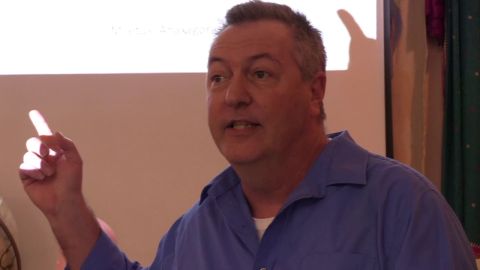
Simon Kidd, real name Wikipedia editor |
Moreno had formerly derided my legitimate reference to The Communicator as an academic in Australia. The Wikipedia report from The Communicator himself was implied by the sectarian blogger as being contrived. Yet now, two years later, Moreno was reproducing the Wikipedia User page of Kidd, which included more substantial details of the latter’s academic career. See User: Simon Kidd. Moreno was now referring to Kidd as “a Senior Research Officer in Education Policy at the University of Western Australia.” The sectarian covered up the acute discrepancy in his statements by inventing the story that Kidd was an “internet propagandist” for myself. The true context for Simon Kidd is reflected in his blog Education, philosophy and more.
While preparing his revisions, Jamieson added a Criticism section to the Kevin R. D. Shepherd article, spotlighting the opposition of Gerald Joe Moreno to my output. He mentioned the 2006 User page of SSS108 (alias Moreno). When this addition emerged online, a rather speedy administrative action removed the Criticism, which was stated to be "inappropriate and potentially libellous." This was in December 2009. In view of subsequent comments, I have been advised to reproduce the deleted paragraph here (divided into two for readability):
CRITICISM
The criticism most in evidence has come from an American defender of the Sathya Sai Baba sect. Gerald Joe Moreno, of New Mexico, has frequently attacked ex-devotees of Sathya Sai Baba and asserted an explicit campaign against critics of the guru, including outsider Kevin R. D. Shepherd. This campaigner attacked Shepherd on a Wikipedia User page under the pseudonym of SSS108. The page was entitled User:SSS108/Kevin Shepherd. This was in October 2006, when Shepherd had not even heard of Moreno. In a book published in 2005, Shepherd had included three appendices reporting ex-devotee testimonies. This coverage was considered by Moreno to be reprehensible, though more especially because one testimony came from Robert C. Priddy, the major ex-devotee opponent of Moreno. The hostile User page attacked Shepherd’s publishing imprint Citizen Initiative as being irrelevant to Wikipedia for reasons of self-publishing. Due to other factors, Moreno was subsequently banned from Wikipedia in March 2007. He afterwards wrote a blog item against Shepherd that same year, linking the latter’s name with Robert Priddy. This was before Shepherd had posted any counter to Moreno.Gerald Joe Moreno has frequently used pseudonyms such as Equalizer, though he has also used his real name. His extensive web output denounces the reports composed by ex-devotees. Moreno regards all criticisms of Sathya Sai Baba as invalid, and presents all critics as being in dire error. His view is that because critics “expose” Sathya Sai Baba, they themselves must be “exposed.” He has become notorious for strongly accented attack blogs on specific individuals, of which nine show at blogspot.com, including one on Shepherd. Moreno (alias Equalizer) asserts a specific campaign in these blogs against criticism of his guru, who has become controversial for alleged misdemeanours. Gerald Joe Moreno is also noted for a strong infiltration of the Google Search name lists of his targets. In November 2009, over twenty of his hostile entries could be found in the first eight pages of Kevin R. D. Shepherd’s Google name list. Shepherd is a complete outsider to the Sathya Sai Baba movement, never having been a devotee. Many readers view the Moreno attack on Shepherd as extremist.
In an annotation, Jamieson juxtaposed two web links to the Criticism section. One link was to the Moreno feature at blogspot which claimed to "expose" me, and the other was to my objection at Internet Terrorist Gerald Joe Moreno (2009). Thus, both versions could be conveniently viewed. See also the ex-devotee reports at Robert Priddy and Barry Pittard. See also section 9 below.
The administrator who commented to Jamieson about the deleted Criticism section was called Vassyana. He stated, on 7th December: "The edits [of Jamieson] violated our principles protecting living persons, against original research, and prohibiting the use of Wikipedia for agendas and axe-grinding." Jamieson was evidently puzzled by this emphatic approach. He expressed an objection on his User talk page dated 11th December 2009. This included the information:
Unfortunately, there is a Wikipedia User page for that person [meaning Moreno] (User:SSS108/Kevin Shepherd) still currently and prominently linked to Shepherd on the web through Google, and yet without any reference displayed that the User [Gerald Joe Moreno] was in fact banned. Let me be clear, that User page originated as 'axe-grinding' exercise against Robert C. Priddy.... Please note that Shepherd was at the time oblivious of all this and had nothing to do with the bickering. I personally feel that the Wikipedia User page in question should be removed as it is being inappropriately employed as part of an ongoing 'axe-grinding' activity against Shepherd, and thus draws the name of Wikipedia into disrepute.
Vassyana was unrelenting in his response of 13th December, giving the explanation: “The main problem about the deleted material is that it was insufficiently sourced and contained negative assertions about a living person; I do not think the material can be reincorporated into the article without violating several Wikipedia principles.” Negative assertions about another living person (myself) meant nothing in this argument. Jamieson had linked (in the deleted text) to the 2006 Wikipedia User page of SSS108 (Gerald Joe Moreno), which was the origin of these problems. However, the Wikipedia administration was clearly unwilling to resolve any issues of stigma or libel befalling victims of Wikipedia editorial policy, even if the User/editor (in this instance Moreno) was banned indefinitely for activist editing in 2007 (section 1 above).
Vassyana further insisted: “Wikipedia articles should not use Wikipedia itself as a reference in any way” (User talk: Alex jamieson). This official attitude is open to the accusation that Wikipedia escapes any self-correction, and is not accountable to procedures of assessment in favour elsewhere. This issue decoded to: Activist editors can express stigma in Wikipedia User pages showing on Google Search, but Wikipedia must not be confronted with the discrepancy.
There followed the Vassyana verdict: “We, as editors, should be neutral and only report what the body of reliable sources states about a topic.” He did not specify any reliable sources, having dispensed with any criticism of an insufficiently sourced and negative Wikipedia User page (showing on Google Search until 2012). The living victim (myself) of sectarian stigma and hostility has countered many negative assertions that originated on Wikipedia, a media which does not always inspire anything resembling a neutral point of view (NPOV).
It was not until 2012 that Jimmy Wales, the Wikipedia manager, deleted the offensive SSS108 User page, in recognition of the substantial discrepancy involved (section 13 below). This action effectively negated the "neutrality" of Vassyana and other administrators, who were indifferent to an injustice and proved incapable of rectifying the problem so obvious to observers.
5. The Zoroastrian Issue
In the deleted Criticism section at his article Kevin R. D. Shepherd, Alex Jamieson had also mentioned (in an annotation, not in article text) a Wikipedia discussion page that bore a misleading and hostile reference to myself. This reference came from a pseudonymous editor who approvingly linked to the major Moreno blog. That editor, named Redletternight, stated contemptuously: “It appears that Kevin Shepherd is doing original research by self-publishing his own books and quoting himself here on Wikipedia.” This erroneous opinion was based on a sectarian item of Gerald Joe Moreno, comprising a partial adaptation of his stigmatising User page of 2006. Redletternight approvingly linked to the Moreno attack entitled Kevin Shepherd and Robert Priddy (July 2007), showing on a blog at wordpress. That blog bore the pseudonym of Equalizer, the cult name of Moreno.
The misleading reference of Redletternight (dated April 2009) was a blatant violation of NPOV (neutral point of view), an ubiquitous Wikipedia rule. The discrepancy was found on the discussion page of Sheriar Mundegar Irani (Wikipedia article). This scandalous reference abused my book From Oppression to Freedom (Cambridge 1988), which was cited in the lastmentioned article. The deleted Jamieson annotation stated that this book:
as a whole amounts to a defence of the oppressed Zoroastrian minority in Iran, and employs diverse source materials of relevance, some of which can usually only be found in academic libraries. Like the other books of Shepherd, this is not ‘original research’ in the Wikipedia sense. From Oppression to Freedom was approvingly cited in the original Wikipedia article on Sheriar Mundegar Irani by a British university academic, whose pseudonym in 2006-7 was Jedermann. Some time after he had posted the original article on Sheriar M. Irani, Jedermann informed Shepherd in private correspondence that the latter’s book was the inspiration for the article, and therefore he had given the book prominent citation. The article was altered by subsequent editorship, acquiring glosses from the Meher Baba movement. Jedermann left Wikipedia because of his discontent with inappropriate editorship; this was the reason he gave in private correspondence with Shepherd in 2007. The second contributor to the Sheriar M. Irani article in 2006 was an American devotee of the Meher Baba sect, and one who expressed respect for Shepherd in private correspondence with Jedermann, though he was apparently not familiar with the book by Shepherd, which was retained in the article references. In contrast, the subsequent defamation of April 2009, from an unknown source, was not consistent with NPOV.
I can here confirm that the Jamieson version was accurate. I have the correspondence with Jedermann on file. Jedermann was the Wikipedia alias for Dr. Michael Emmans Dean (University of York). He was interested in my research on Zoroastrianism, himself having a genuine interest in that subject (he was not a specialist in Iranian religion). He is a very scholarly man and skilled in annotations. He told me of the new article on Wikipedia some while after he had posted it, as I was not aware of it. Jedermann was concerned when the American devotee enlarged that article in 2006, adding references to Meher Baba devotee preoccupations that did not fit his (Jedermann’s) original context of Zoroastrianism. Jedermann was amicable with the new editor, but was disconcerted. He afterwards retreated from Wikipedia for such reasons, and talked privately of moving on to Citizendium, where different priorities were in prospect. Jedermann quietly exited from Wikipedia in March 2007. See further Wikipedia Sectarian Strategies.
The original version of the Sheriar Mundegar Irani article subsequently showed at Citizendium (accessed 13/02/2013), where the author gives his real name on the talk page and provides information as to context: "Article rescued from WP (Wikipedia) and edited back to the impartial state I left it in before followers of Meher Baba adopted it and turned it into a devotional exercise" (Mike Emmans Dean, 21 March 2007). The devotee version of the same article was deleted from Wikipedia in 2018, as part of a new editorial reaction to articles maintained by a Meher Baba devotee employing the pseudonym of Dazedbythebell.
Meanwhile, nine years earlier, on his User talk page, Jamieson requested Wikipedia advice as to how best to reincorporate the deleted criticism section of his article and the accompanying annotations "in a manner that would conform to Wikipedia policy." The administrator Vassyana effectively dismissed the relevance of this issue, instead stating: “I will post a message at the Reliable Sources Noticeboard to ask for some outside opinions from editors who deal with reliability issues.” Vassyana, 13 December 2009. User_talk:Alex_jamieson.
The new message on the Reliable Sources Noticeboard read as follows:
There is some confusion and disagreement at Sheriar Mundegar Irani over whether Anthropographia Publications, as well as Philosophical Press and New Media Books Ltd, are reputable publishers. If the publishers are questionable, would Kevin Shepherd be considered a sufficient expert in the field to qualify the sources for use under WP:SPS ? Thank you for any assistance and feedback in this matter. Vassyana (talk) 17:42, 13 December 2009.
This memo was substantially flawed, relying upon the sectarian blog libel of Gerald Joe Moreno as featured via quotes and a very dubious link on the discussion page of Sheriar Mundegar Irani. There was no attempt to consult my objections as found in the links provided by Jamieson. Moreno attributed all three publishing imprints to me, whereas only Anthropographia was mine. New Media Books Ltd does not exist, being the creation of Moreno. In short, Wikipedia administration was here caught in the act of deferring to a sectarian blog in confusion with "reliable sources." The procedure was farcical.
Wikipedia administration deleted the objection made by the detailed annotation of Jamieson, and instead retained at the disposal of readers the sectarian misrepresentation of Moreno, via the references by Redletternight on the discussion page of Sheriar Mundegar Irani. The Wikipedia User page of SSS108 (Moreno) was also retained to my disadvantage, there being no due ethical scruple amongst the Wikipedia administration.
Observers subsequently discovered (in December 2009) that the link to a Moreno blog disappeared from the discussion page to Sheriar Mundegar Irani. What remained were totally anonymous quotes from Moreno (via Redletternight) that were adverse to my books, but without giving the source of the quotes, which derived from the 2006 Wikipedia User page of SSS108 (alias Moreno). Thus, the identity of Gerald Joe Moreno remained elusive and anonymous; even the blog identified him as Equalizer, his cult name on both wordpress and blogspot.
The basic point to grasp is that direct Moreno interference on the specified discussion page was now strongly implicated. Knowing that he could be tracked in the new focus of attention, Moreno evidently deleted the link, unless one chooses to believe that a Moreno supporter on Wikipedia accomplished the desired deletion on his behalf.
There was only one response to the Vassyana memo, which appeared under the heading Anthropographia Publications. This came from Itsmejudith, who started with: “Hmm, not an easy one. My instinct is no. He seems such an interesting scholar, but what actually is his field?” Wikipedia editors never read the books they commented on, so any context was merely remote opinion. The most relevant book here was From Oppression to Freedom, which featured by far the most lengthy biography in print of Sheriar Mundegar Irani, the subject of the Wikipedia article that had aroused complaint in relation to the aborted discussion page. All connections and relations were completely lost upon the presumed experts at the Noticeboard.
The same instinctive editor contributed to the next item on the noticeboard, entitled Persecution of Zoroastrians. This discussion displayed a general unfamiliarity with Zoroastrian history, and a pronounced confusion in relation to sources. One editor referred to the commencement of Islamic rule in Iran, attempting to mitigate the factor of any persecution of Zoroastrians. The interpretation of events was substantially inadequate. Another editor mentioned that a book by Mary Boyce (Zoroastrians: Their Religious Beliefs and Practices) was “probably the best extant source on Zoroastrianism.” There are quite a lot of other sources (including the major multi-volume work by Professor Boyce), and in different languages. These people had clearly not read much in the field at all, including my own book From Oppression to Freedom (which cited Prof. Boyce, amongst many other scholars). I am more than slightly familiar with the varied works of Professor Mary Boyce. See The Zoroastrian Centuries (2008), which is subtitled Some events in Zoroastrianism and a commemoration of Mary Boyce.
By way of extension here, I could add that my book From Oppression to Freedom referred to the Safavid and Qajar eras of Iranian history. Despite the Wikipedia assumption that the Zoroastrians had never suffered anything much, I gave tangible references in my dismissed book to harassments from Islam. There was also a notorious massacre of Zoroastrians occurring at Isfahan in late Safavid times. The Wikipedia editors, summoned to the Reliable Sources Noticeboard, showed no knowledge of these phases. Their role as social commentators was pronouncedly deficient.
 |
The Reliable Sources Noticeboard discussion queried sources like the BBC and Encyclopaedia Iranica. Observers were staggered to find that the latter source was so strongly questioned by these “expert” Wikipedians, one of whom stated:
The BBC site is an RS. Economic Expert appears to take its material from Wikipedia, so it is not an RS. It is unlclerat (sic) whether Encyclopaedia Iranica will be an RS [Reliable Source]. It appears to be self-published, although an editorial board is mentioned.
The discussion continued to cast doubts upon Zoroastrian websites. There was also a statement: “The Encyclopaedia Iranica, looking at it again, seems to have the blessings of Columbia, but doesn’t seem to be actually run by them.... It does seem to have an impressive list of contributors, though, and an editorial board. So that means, IMO, it looks like it is an RS, unless anyone knows of any other reasons why it isn’t” (Former IP, 14 December 2009).
Not quite saving the day, this idiosyncratic discussion ended with the reflection: “Regarding Encyclopaedia Iranica, I thought I should mention that the Wikipedia page for it says that the wikipedia page for it does say that it is published by ‘Center for Iranian Studies, Columbia University' ” (digitwoman, 14th December 2009). The quote is verbatim.
These people clearly had no familiarity with what they were discussing. The extent of this drawback is confirmed by remarks about Encyclopaedia Iranica, which was questioned as a reliable source on the Reliable Sources Noticeboard. The internet elsewhere appropriately described this work as "the most extensive compendium ever conceived on the past and present culture of the peoples who speak an Iranian language."
In such elevated company as Encyclopaedia Iranica, I am happy to have been marginalised by the Wikipedia Reliable Sources Noticeboard. The relegated encyclopaedia happens to be the authoritative digest on Iranian subjects, with a long list of eminent professorial (and real name) contributors that substantially eclipses the haphazard commentaries on Wikipedia noticeboards. I have been acquainted with Encyclopaedia Iranica since it commenced many years ago in the original fascicule format. I have cited that formidable work frequently in my books and web writing. See my web articles Zarathushtra and Zoroastrianism and Early Sufism. I still hold a very high opinion of Ency. Iranica contents, and wish to be remembered in that light.
My conclusion is that Wikipedia Noticeboards are some of the least reliable resources of information about what is supposedly being discussed. See further section 12 below.
It was not until 2012 that Wikipedia manager Jimmy Wales prudently deleted the misleading comments of Redletternight on the discussion page of Sheriar Mundegar Irani. Wales grasped that a serious distortion had occurred, one directly contradicted by the highly visible files of Citizendium. The Vassyana episode is now considered something beyond a joke to hardcore analysts, and a testimony to the extreme drawbacks occurring on Wikipedia. See also Fifelfoo Ignores Citizendium [and Wikipedia Matters]. Also of relevance is Sheriar Mundegar Irani and Zoroastrianism.
6. Arguments For and Against Article Deletion
On December 15th, 2009, Smartse suddenly moved (without warning) to delete the article Kevin R. D. Shepherd. Another editor (Dazedbythebell, of sectarian association) applied a template (or banner) stigmatising the article as “autobiography.” Alex Jamieson (real name Stephen Castro) complained at this tactic, because he was the composer/editor of the article and had not finished his revisions. There had been no prior discussion of this matter. The template was imposed at the top of the article without warning. Some observers deemed this gesture to be an act of vandalism.
The close coincidence in time with the strategy of Vassyana (section 5 above) was perceived elsewhere. The fact that links were showing on the AfD page to libellous attack blogs of Gerald Joe Moreno, to my discredit, has been considered flawed practice. The agent of malpractice was Dazedbythebell, a supporter of Meher Baba, and very active at the Meher Baba article. The pro-sectarian attack blogs of banned activist editor Moreno (alias Equalizer, alias SSS108) were used as a support in the argument for deletion.
Christopher Ott |
Dazedbythebell is now identified with Christopher Ott, a prominent American Meher Baba devotee active at the Myrtle Beach Centre of the Meher Baba movement. Ott is known to have maintained a set of Wikipedia articles relating to his favoured subject, which he formatted unobtrusively (those articles were deleted in 2018, when the pattern of devotee output was becoming obvious). The effective presence of the Myrtle Beach Centre in the deletionist episode has hidden agenda significances of a proscribing sectarian complexion.
Some observers noticed that Smartse sent a message to Jayen466 on 19th December, which read as follows: “Hi, I should have told you about this a while ago, sorry for not. The discussion could do with some more editors who have nothing to do with the topic adding their opinion. See Wikipedia: Articles for deletion/Kevin R. D. Shepherd. Cheers Smartse” (talk) 22:39, 19 December 2009. This influential communication occurred at User_talk:Jayen466/Archives. Jayen466 also displayed the identity of JN466.
There were already a couple of editors who were strongly in opposition to the article under discussion. Two against two was too even for the odds in administrative terms. Jamieson and Kidd were opposed by Dazedbythebell and goethean. A feasible deduction is that administrator Smartse wanted (or anticipated) a defeat for the former two. He certainly knew that Jayen466 was opposed to the article (section 3 above). It is relevant here to summarise the Article for Deletion (AfD) discussion, which was lengthy; this overview will comprise sections 6, 7, and 8 of the current contribution.
Smartse commenced the AfD page entries on December 15th (2009) with a complaint that the article was based on primary sources, and that he could not find "any secondary sources to demonstrate that this person [Shepherd] meets Wikipedia:ACADEMIC # Criteria." I have never claimed to be an academic, only a citizen philosopher and a "serious amateur" as recognised by some liberal academics.
Also on December 15th, the editor Dazedbythebell markedly deviated from the abovementioned contention of Smartse. He urged that Jamieson “appears to be Kevin Shepherd,” and provided the “self-made photo.” This erroneous opinion was further expressed in terms of “appears to be self-promotion using Wikipedia.” The accusation was strongly reminiscent of the Redletternight suggestion elsewhere (section 5 above), made on the basis of a Gerald Joe Moreno blog. The influence of Moreno in this discussion was very tangible.
The sectarian influence was abundantly demonstrated via Dazedbythebell, who provided a fairly lengthy quote from a Moreno blog (related to the 2006 Wikipedia User page of SSS108). Dazedbythebell gave no details of his quoted source, merely describing the source in terms of: “This information about Kevin Shepherd is problematic.” The outright reliance upon a sectarian source of misleading information says nothing for the standards of AfD protocol, especially in view of contrasting data which had negated the sectarian dismissal. See section 9 below.
Alex Jamieson (real name Stephen Castro) objected to the equation of identity, stating:
Smartse, I will undertake the necessary edit of the Kevin R. D. Shepherd article. Kindly do note that I am not Kevin R. D. Shepherd, as is implied above. Also, the quotes being used to support the “argument” for deletion originated in the Wikipedia User page of an individual [Gerald Joe Moreno] who was banned, and for reasons well known. I am appalled by the unscholarly behaviour in evidence, and that sectarian interests appear to be involved. Alex Jamieson (talk) 17:46, 15 December 2009.
Simon Kidd then stated: “I dispute the neutrality of this nomination: Dazedbythebell appears to edit articles related to Meher Baba almost exclusively. I would suggest, therefore, that Dazedbythebell has a special interest in Meher Baba (a biography of whom has been written by Kevin Shepherd), and his neutrality is questionable, to say the least. The information on the page cited [the Moreno attack blog] is extremely biased, as it relates to a highly controversial dispute that originated on the talk pages of the Sathya Sai Baba article, and spilled over into external blogs. There is no evidence that Kevin Shepherd has been editing under the name 'Alex Jamieson'. He has stated that he has "never been a contributor to Wikipedia." .... The issue of statements about Shepherd is arguable. As I pointed out in my comments of 10 November 2009 here, almost all of the statements in the article [about Shepherd] are statements not about Shepherd himself, but about his views as expressed in his writings, and the latter are therefore the best source for the statements.” Simon Kidd (talk) 18:27, 15 December 2009.
Dazedbythebell replied very briefly by saying that: "Actually the nomination [for deletion] was made by Smartse." This comment was accurate, but rather a lot here remained unanswered.
There followed a statement which has attracted much attention, and one that evidences the total neglect of relevant details which administrators should have known about, including the 2006 User page of a sectarian activist editor who was subsequently banned.
Smartse then made a comment which included the phrase:
I'd never heard of Meher Baba or Sathya Sai Baba before this, but it doesn't really matter - we are just here to discuss this article.
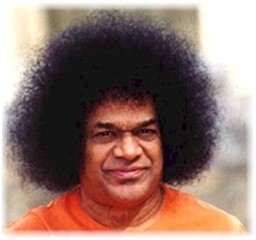
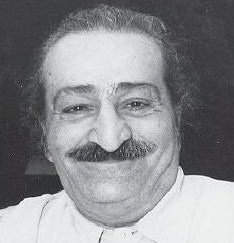
l to r: Sathya Sai Baba, Meher Baba |
Some outside observers disagreed with the verdict about what did not matter. One of the marginalised Asiatic figures was very relevant to the Criticism section of the article, which had been deleted by the administration. Moreover, critics affirm that the article could not be appropriately discussed without due reference to the complicating factors in train about these two Asiatic celebrities (Moreno being a partisan of Sathya Sai Baba, and Dazedbythebell being a partisan of Meher Baba). Dazedbythebell is the pseudonym of American devotee Christopher Ott, prominent at the well known Meher Spiritual Center, Myrtle Beach. Smartse was now in association on Wikipedia with a major representative of the Meher Spiritual Center, whose partisan biases were camouflaged by pseudonymous editorship.
Smartse added: "Blogs aren't considered reliable so whatever it says doesn't matter here." The rather casual comment evidently referred to the Moreno blogs favoured by Dazedbythebell. Despite this convenience of dismissal, the blog issue does matter, because the administrator Vassyana had favoured the sectarian blog version of myself on the Reliable Sources Noticeboard, and after condoning the abrupt excision of the Criticism section in the article under discussion. The fate of Encyclopaedia Iranica on a Wikipedia Noticeboard is more than slightly memorable (section 5 above).
Another editor named goethean stated: “He (Shepherd) sounds like a bit of a crank, sending letters to people and taking their lack of response as evidence that they are untrustworthy....The logic is less than compelling. I may have a slight conflict of interest, having edited articles about people that he criticises, but it seems like he criticises a lot of different people.” goethean, 21:13, 15 December 2009.
The hostile editor here quoted two brief sections from my web introduction to my lengthy Letter of Complaint to David Lorimer (2005), circulated in 2006 to 500 recipients. The quotes referred to over 60 members of the Scientific and Medical Network as not having replied to a relevant document, a factor arousing scepticism. Only one member of that organisation had replied (not David Lorimer, be it noted). In such public circulations, the absence of reply from an organisation is often considered to be proof of evasion. There were also over sixty British politicians on the cc. list, a factor supporting the relevance of acknowledgment. Such well known entities as David Cameron made duly responsible replies.
Smartse interposed: “It doesn’t make any difference whether or not he is a crank. Please keep to comments about the article and whether he is notable instead.” Smartse (talk) 22:33, 15 December 2009.
Observers afterwards discovered that goethean had long been involved in editing the article about Adi Da Samraj, appearing on the relevant discussion page. “My interest in Adi Da stems from my interest in Ken Wilber.” Goethean, 16 December 2009. The quote comes from User_talk:Goethean/2009#Adi_Da.Reliable Sources. I had criticised both Adi Da and Wilber (though in different ways), and was not by any means alone in this recourse. Ex-devotees of Adi Da Samraj (d. 2008), aka Franklin Jones, have repudiated his extravagant claims and provided revealing data that is not in his favour. Ex-supporters and other critics of Ken Wilber have lodged many objections to Wilber and his integral theory at Integral World.
There followed another contribution on the AfD page from Dazedbythebell, who queried my studies at Cambridge University Library in a rather flippant manner. He focused upon the Jamieson citation of my book Meher Baba, an Iranian Liberal (1988). Dazedbythebell was evidently in reaction to the non-sectarian nature of that book. This undeclared representative of the Myrtle Beach Meher Baba Centre insinuated that Jamieson had misunderstood what a citation is. Jamieson made a firm reply in his subsequent lengthy statement reproduced in large part below.
Cambridge University Library (CUL) |
My studies at CUL were sponsored by a well known Cambridge academic, and I was on good terms with the Admissions Office for many years. I have been told that the demeaning comment of Dazedbythebell was an insult to both myself and CUL. "He learned what he knows in a library?" Many researchers have learned at CUL, including eminent professors. There are sufficient journals in that library to command attention for years on the part of any researcher. Many Wikipedia editors do not cite learned journals. In a lengthy book, I provided thirty abbreviations for journals and academic series cited in the notes (Minds and Sociocultures, 1995, pp. 826-7). Now on Wikipedia, such protocol was dismissed by sectarian biases.
Smartse then appeared to agree with Dazedbythebell. He added: "Ideally we need an article in a magazine or newspaper" to confirm notability of the article subject. In contrast, some academics adopt the view that magazines/newspapers are no guide to intellectual apparatus, and that what counts most is a demonstration of commitment at a level well above newspaper coverage.
There was an extension to this online situation. Only half an hour later, Smartse issued a Request to Dazedbythebell, a gesture which clearly indicated that he (Smartse) could perceive discrepancies in the AfD situation. This request, together with the response, initially appeared on the AfD page, but was soon afterwards deleted (not showing on print-outs of 20/12/2009). That further excision aroused critical comment from outside observers, who suspected a degree of manipulation in the ongoing events. The excision included the following, which exhibited a separate heading:
REQUEST
"Please keep discussions on topic. I really can't see why you needed to post these links [of Gerald Joe Moreno] into Wikipedia Articles for deletion/Kevin R.D. Shepherd. I'd recommend that you strike through them as they seem to show that you are trying to push an agenda into the discussion. This is unnecessary when it already looks as if there is not enough secondary coverage to merit the article." Smartse (talk) 23.04, 15 December 2009.
"Sorry if it looked that way. What happened is I went to try to find out if Shepherd has some credentials, etc. But quickly came to those [hostile sectarian attack blogs]. The point is that Shepherd doesn't seem to be a notable academic at all. I also believe those editors [unnamed] are either him or meat puppets. The only proof given that they aren't is Shepherd's word for it on his own website. That is circular reasoning, isn't it? Anyway I have now removed the links." Dazedbythebell (talk) 23:22, 15 December 2009.
There are two basic deductions to be made at this juncture, and which do not support the erroneous argument presented by a Wikipedia editor in the Request feature.
Firstly, Dazedbythebell was again drawing heavily upon the Moreno version of events, which had ridiculed two academic editors associated with Wikipedia (namely Jedermann and The Communicator). Dazedbythebell had even failed to register the elementary point that Simon Kidd had disproven the Moreno denial of The Communicator, appearing in 2007 on the sectarian attack epic known as saisathyasai.com. Kidd had since divulged his former identity as The Communicator, his Wikipedia pseudonym (section 4 above). "Shepherd's word for it on his own website" was not enough for pseudonymous Wikipedia, who instead maintained a fantasy of identity. I was here being mistaken for two academic editors, whose standing had been dismissed by Gerald Joe Moreno as a fiction of my invention. These abused academic entities were now merely "meat puppets" in the commentary emanating from the Myrtle Beach Meher Baba Centre. The proof of identity was acutely contracted. Some analysts have been amazed at the deceptions and errors involved in this AfD issue, not to mention the factor of injustice. The "circular reasoning" on Wikipedia was phenomenal.
I have named the other academic editor (Dr. M. E. Dean, alias Jedermann, derided by Moreno) above (section 5). Both Moreno and Dazedbythebell failed to register the known real name identity of Dr. Dean at Citizendium, an event occurring before my commemoration in 2007. Dr. Dean had migrated from Wikipedia to Citizendium in exasperation at the interference with his work by Christopher Ott, who had added devotee "decorations" to his article on Sheriar Mundegar Irani. I was quite justified in contradicting Moreno, Citizendium being immune to polemicist lore. I am not capable of being identical with academic editors of such ability; they are no more puppets for me than they are of Gerald Joe Moreno or Dazedbythebell (Ott). I have never claimed to be a notable academic, which is one of the basic reasons why I inaugurated the Citizen Initiative logo, representing the underdog in the philosophy of culture.
Secondly, we have the situation in which the presiding administrator (Smartse) on the AfD page had not heard of two famous Asiatic guru figures, both of whom were mentioned in the contested article, and one of whom was significantly mentioned in the Criticism section deleted by the administration earlier that same month. Editor Dazedbythebell (Ott) was an evident supporter of the Meher Baba movement, as Simon Kidd had deduced. His agenda of affinity with hate campaign blogs remains a very suspicious tactic. Further, the fact that sectarian attack blogs associated with Sathya Sai Baba were strongly linked to the AfD page, is a notable discrepancy with NPOV. These blogs were now considered unfit for public viewing, and hence deleted. However, the attendant sectarian agenda had already been influential, and apparently to an extensive degree.
I was vicariously identified, in the statements of Dazedbythebell, as being no less than three different entities: Jamieson and two academics, one of them a Ph.D. At the same time, the two academics were described as "meat puppets," a fiction not penetrated by Wikipedia deletionists, including Smartse. The hostility against myself that was engendered by such confusions has been lamented in some directions, but too late. The long shadow cast upon these and other events by a sectarian cyberstalker is quite sufficient to hold the deletionist proceedings in long-term query.
These acute anomalies have been described in minimal terms of (a) lack of acquaintance with real name editor events, and (b) flawed AfD process.
The Wikipedia cosmetic factor also deleted the following exchange in the Request feature:
Your points may well be true but adding links to sites that slag him [Shepherd] off don't really help in the discussion. I'm assuming good faith on the COI and puppet ideas for the moment. Thanks for removing the links. Smartse (talk) 23:40, 15 December 2009.
I could see your point and that's why I removed them [the links]. I was, like you said, getting off topic. The nomination is for deletion due to notability, and those links diverted attention from that topic. What I meant to show was that he [Shepherd] isn't a notable scholar, but it came off like I was just slagging him for some personal thing. Dazedbythebell (talk) 23:45, 15 December 2009.
Smartse's genuflection to certain hostile views ("your points may well be true") strongly implies that he may have been influenced, however indirectly, by the sectarian blog output which had become conspicuous at this juncture. He was certainly "assuming good faith" in the diversion, created by Ott, which made others believe that I was the same entity as Wikipedia editors who included Simon Kidd. There was evident reluctance to read what the victim said in objection to the activist editing of a 2006 Wikipedia User page and closely associated attack blogs. See section 9 below as an alternative to Wikipedia format.
The fact that sectarian cyberstalker attack blogs were employed in an AfD process has aroused strong comment. Some analysts say that the AfD procedure was not valid, clearly originating in a climate of opinion influenced by libellous materials not belonging in any responsible encyclopaedia file. Smartse recognised too late that the offensive blogs could not be regarded as reliable sources. He nevertheless remained sympathetic to the tangible hostility of Dazedbythebell, who evidently influenced him at least partially. These two pseudonymous entities were complicit in applying the stigmatising "autobiographical" banner to the Kevin R. D. Shepherd article, a reported action of Dazedbythebell, who wished to delete the article in a mood of strong convergence with American cyberstalker attack blogs.
When the Request feature was quickly deleted, Smartse petitioned Jayen466 for support, deducibly against the editors in my favour, as recorded above. The opposing comment of Jayen466 effectively replaced the Request. Outside observers assimilated this development with due critical reserve; the mood was sufficient to dispel any belief in the surpassing correctness of AfD procedures. Smartse subsequently stated: "I informed Jayen466 of this discussion as advised at WP:AFD#Notifying interested people." Smartse (talk) 20:13, 20 December 2009.
Jayen466 (JN466) entered this debate on 19th December, advocating deletion, and stating:
In terms of demonstrating notability, some citations of Mr. Shepherd’s books have indeed been added to the article. However, evidence that an author is cited by other scholars, while it reflects a certain amount of acceptance in the scholarly world, is not by itself sufficient to satisfy WP:N, which asks for sources that ‘address the subject directly in detail.’ There are many quite eminent and widely cited scholars who do not have Wikipedia biographies devoted to them; even if Mr. Shepherd was more widely cited, he would be in august company in not having a Wikipedia biography. In conclusion, and with regret, I have to say delete, unless multiple other sources can be found that cover this author 'directly in detail'. JN466 23:40, 19 December 2009.
Alex Jamieson then contributed a lengthy statement against deletion. Some excerpts are here given:
“I do strongly object to the accusation of Dazedbythebell that I am Kevin R. D. Shepherd. In my view it was inappropriate to have imposed the 'autobiography' template on the Shepherd article page, and I do now request that the template be removed [the template was applied by Dazedbythebell]. The accusations and commentary of Dazedbythebell are very misleading, and exhibit a thorough non-acquaintance with Shepherd and his works (both published and online). This is indeed surprising given the editorial association [of Dazedbythebell] with the Wikipedia article related to Meher Baba. As far as I am aware, Shepherd’s book Meher Baba, an Iranian Liberal, was the first full length critical scholarly work on that subject.... that book has an interesting history within the Meher Baba sect. When the book was published, Tom Hopkinson (a prominent devotee, now deceased) was notified.... Hopkinson responded by saying that he and his Association (the Meher Baba Association, based in London) did not want to see or read books on comparative religion, which was the category in which he placed Shepherd’s work. His reason being, 'we are only interested in Meher Baba.' (See Shepherd, K.R.D., Investigating the Sai Baba Movement, p. 260 note 468). That is an example of the sectarian mind.
“As for the so-called ‘self-made photo’ it was created by me, and it was I, and not Kevin R. D. Shepherd, who uploaded the image and placed it in the article. I asked Shepherd for his permission to post the image on Wikipedia, and he agreed, saying the article did fairly represent him. So the accusation of “self-promotion using Wikipedia” is a serious error amounting to defamation.
“The problem with Shepherd has been, not any urge for self-promotion, but rather a strong inclination to the contrary. Over the years, his friends and acquaintances pressed him to be more publicity-wise, and to appear on the web. He consistently refused, preferring the retired lifestyle of a writer and researcher. He has been quite genuine about research as distinct from commercial interests. It was not until 2007 that Shepherd appeared on the web, after his strong opposition to that medium lasting many years. He only relented when he was persuaded that, if he did not, then relevant materials would be lost to public view. Only then did he release his image, after 25 years of preferred obscurity....
“Dazedbythebell weakens his case by quoting extensively from the very unreliable Wikipedia User page of SSS108 [Gerald Joe Moreno], dating to 2006 (and part of which was subsequently adapted in a Moreno blog).... Shepherd’s contrasting commentary is not even mentioned, and this fact to me indicates a serious problem in Wikipedia procedures, and one requiring due attention.... SSS108 emphasised his alleged email contact with the University of Sheffield, saying the books of Shepherd could not be located by Mrs Barringer in any list of publishers. To my knowledge, Shepherd’s books are held in other British academic libraries, e.g., two at the School of Oriental and African Studies, so why stop at Sheffield? Please note that Shepherd was even then on Amazon, and has also featured for years in the Directory of UK and Irish Book Publishers, a major guide jointly published by the Booksellers Association and Nielsen Bookdata. Even a glance at Amazon would have sufficed to authenticate the author.... To offer a counter quote to be found on that same User page, here are the concluding comments by an academic editor who disputed the now banned SSS108: 'It is clear that Kevin Shepherd’s work is in good repute with academic researchers in Comparative Religion.'
“The fact that Dazedbythebell can approvingly cite a known sectarian [Gerald Joe Moreno, alias Equalizer, alias SSS108] is sufficient reason to query his intentions. His other references are in a similar bracket for sober analysis. He derogatorily (doubtless another fine example of Wiki etiquette) refers to other editors that 'are either him [Shepherd] or meat puppets.' He calls Shepherd's version 'circular reasoning,' but the incongruous reasoning of Dazedbythebell is again derived from the libellous tactics of SSS108, which are increasingly notorious in educated sectors outside Wikipedia."The comments of Dazedbythebell on references in my article can be interpreted as support for sectarian campaign against non-believers. That Wikipedia should be an organ for this type of approach is lamentable. 'Not one statement about Shepherd is quoted from a non-Shepherd third party source.' This attitude is clearly determined to overlook my quotes from two academic scholars in the field of Indology, who both acknowledged that Shepherd’s work had anticipated the Muslim identity of a famous subject (Sai Baba of Shirdi) more casually investigated by some other scholars. This achievement alone would make him notable, as the Muslim-Hindu orientation in South Asian studies is currently an important factor, though unrecognised by Wikipedia, which may now be accused of neglecting Muslim identity in preference for American sectarian campaign against any disbeliever in guru miracles and any critic of alleged sexual abuses.
“....As Simon Kidd has a known academic history of research into Indian and Persian religion (not to mention philosophy), I think we should take his views on such subjects as being more relevant than the sectarian-influenced objection to annotated research. If Kidd decided that Shepherd was worthy of note, then there must surely be some reason based on the recognition of something commendable in Shepherd’s work."Simon Kidd has also pointed out above that 'Dazedbythebell appears to edit articles related to Meher Baba almost exclusively.' This factor makes me very suspicious about the opponent's attempt above to cast doubts upon my reference [in the article] to a non-sectarian work of Shepherd on the subject of Meher Baba. My reference simply noted the salient fact that, although sectarians refused to recognise that book, scholars were not influenced by the sectarian outlook and cited the book. The inclusion of the citation is certainly not a valid argument against notability. That is irrational thinking. This attempt [of Dazedbythebell] surely cannot be coincidence, and yet it is being aired on Wikipedia as though comprising a flawless logical argument. Anyone who reads Shepherd's book on Meher Baba knows that work is not sectarian, though at the same time, he is very fair to the subject. Some Meher Baba devotees objected to the criticisms of some prominent devotees in the movement, but that is no reason to despise an annotated book with a lengthy bibliography. Scholarly procedures are being flouted on this Wikipedia page for deletion. It is Dazedbythebell who misunderstands what a citation is, or should be. A citation should not be impaired by sectarian considerations.
" 'He learned what he knows in a library?' Note the question mark. The content of this adverse reflection from Dazedbythebell is clearly one of casting doubt upon any notability there might be in Shepherd. I would like to know if he has, like Shepherd, spent twelve years at a major academic library, producing many notebooks, and subsequently composing thousands of annotations in detailed and informative books, a number of which only specialist scholars are in any position to pass judgment upon.
“Although Smartse suggests that a magazine or newspaper is an ideal source of confirmation, it is precisely such sources which university academics repudiate. Tabloid preferences are not always any gauge for philosophical or scholarly ability. Shepherd may be admired for his consistent aversion to such profiles. It is clear that Wikipedia has not successfully addressed the overall criteria for notability.
“....Goethean clearly wishes to present Shepherd as a crank, 'sending letters to people and taking their lack of response as evidence that they are untrustworthy.' This is extremely misleading. Shepherd gained notability amongst British politicians when he circulated two printed booklets to 500 recipients in 2006, registering complaints about anomalies in certain British 'alternative' organisations. Though some recipients did not reply, there were a substantial number who did, including David Cameron, Sir Menzies Campbell, and Professor Seyyed Hossein Nasr (the distinguished Muslim savant at the George Washington University). The Scientific and Medical Network (SMN) were conspicuously absent from the reply list, save for one conscientious academic. This fact has evoked accusations of evasion from persons other than Shepherd.
“....Furthermore, the issue of LSD is not a crank issue, and this was one of the complexities involved in Shepherd’s Letter of Complaint to David Lorimer. Shepherd is one of those opposed to Stanislav Grof’s LSD therapy, which has been described by partisans in terms of spirituality. LSD therapy is strongly associated with the SMN via a well known exponent. The people who call this a 'crank' complaint are frankly suspicious, especially on the Wikipedia front. Shepherd is known for objection to the use of psychedelic and other drugs.
“....In conclusion, I would like to point out that university academics are frequently resistant to Wikipedia because of the 'cultism' and sectarian interests discerned to exist in Wikipedia articles and discussion pages. This is believed to operate behind the convenient front of pseudonyms, and to exercise a disastrous effect upon public education. I believe that Jimmy Wales is aware of this factor, though he probably does not get the time to investigate all the problems in his orbit....” Alex Jamieson (talk) 09:37, 20 December 2009.
The reference to Jimmy Wales, alias Jimbo, proved to be appropriate. Over two years later, the Wikipedia manager did at last investigate the problems involved in my direction, and expressed his regret at untoward events. Jimbo did concede that Wikipedia editors could get out of control and become attackers. It was evident that he did not consider administrators as being beyond all scope for error. Jimbo deleted the aggravating SSS108 User page dating to 2006, and also took certain other precautions to ease the situation of harassment, which he did acknowledge in private correspondence. See section 13 below.
7. Wikipedia Exegesis of Simon Kidd
The lengthy Statement by Simon Kidd on the same AfD page amounted to an unusual exercise in interpretation of Wikipedia guidelines. Because this was effectively ignored by the administrators, some attention should be awarded here.
Simon Kidd, real name Wikipedia editor |
The Kidd contribution was divided into two parts: process and substance, and dated 20th and 21st December 2009 respectively. One comment here was:
These [Wikipedia] guidelines have evolved over time, in response to the exigencies that crop up in such an enormous project as Wikipedia. Although they represent a good body of experience, and a certain consensus, they need not be regarded as the last word on every possible circumstance.
Simon Kidd contended that Smartse’s nomination for deletion was based upon a narrow or rigid application of the existing guidelines. “When something new is presented to a judge [in law], it can become a Test Case, leading to the setting of a Precedent. I am going to argue in the ‘substance’ section that the Shepherd article is just such a test case for Wikipedia guidelines.” Kidd then evoked a Wikipedia posting by Vassyana (an administrator) as being significant in revealing that “there is no infallible consensus about issues such as notability and verifiability.”
Further, the editor was able to employ another administrative deliberation: “Smartse himself displays a more lenient attitude elsewhere, even pointing out that Wikipedia guidelines do not forbid editors to create articles about themselves, as long as they are NPOV; the outcome in this case was to keep the article.”
Kidd goes on to observe a further instance of latitude. Dazedbythebell (Christopher Ott) had very recently removed a template calling for additional references to an article he was involved in, a template which had been operative for six months; the problem still remained , meaning that the same four references were present but lacking citations in the article text. "The contrast between Dazedbythebell's attitude here, and his exacting attitude towards citations in the Shepherd article, just six days later, is striking."
Another example of a double standard occurred the previous month, when Dazedbythebell had "supported the inclusion of a reference to [his favoured figure] Meher Baba in a comic book.... and yet he questions the notability of Kevin Shepherd, who (as Alex has pointed out) has actually written a significant biography of Meher Baba." The subjectivity of such attitudes was implied.
Kidd then queried Smartse’s recent deletion of my initials (subsequently restored). There were other articles with evident faults, and therefore “with so much to do in Wikipedia, Smartse, why does the Shepherd article merit such attention?”
The same commentator went on to mention the close connection of Jayen466 with the Osho (Bhagwan Shree Rajneesh) article (section 3 above). Kidd informed that an administrator had recently advised Jayen466 to declare on a User page his history of interest in Rajneesh, as a safeguard against possible accusations.
The analysis of Simon Kidd led to a forthright assertion: “This series of exchanges only seems to strengthen the suspicion that Wikipedia neutrality is being contaminated by a self-serving elite of Admins, who look after one another by various means, including off-the-record private emails. Wikipedia anonymity only confounds the situation.... In short, I think the Wikipedia notability guidelines need to be interpreted carefully.... otherwise it might look like editors are using guidelines to further their own agenda.”
In the second part of his treatment, Simon Kidd remarked: “To my mind, there is a very big question hanging over the process of this nomination [re deletion], given the broader context in which it is occurring (including the blogs referred to, and others that are not referred to).... it is pertinent if latitude exists in the guidelines, and has in the past been demonstrated by editors making submissions here, and yet is not being exercised in the present case.”
Again a warning about complexity. “Unfortunately the guidelines are byzantine in their complexity, presumably reflecting their gradual accretion, and they require an almost forensic disposition to untangle them. As evidence of this complexity, note that in his original AfD (Article for Deletion) nomination, Smartse referred to the academic notability criteria, while in his submission of 20 December, he refers us instead to the General Notability Guideline. In other words, there is not a single guideline but a web of interrelated guidelines, each with its own nuances.... we find that an academic may meet none of the listed criteria and yet ‘still be notable’.... An academic who is not notable by these guidelines could still be notable for non-academic reasons.... in the case of scholars it is often the ideas themselves that are notable rather than the scholar.”
In relation to my own case, this analysis invoked the guideline: “Never use self-published books, zines, websites, webforums, blogs and tweets as a source of material about a living person, unless written or published by the subject of the biographical material.”
The probe ended with:
This article is primarily about Kevin Shepherd’s ideas, i.e., authorial opinion. The best sources for the latter are, as I maintained on this page, the author’s own books. That these books are self-published is not relevant in such a case, as the reliability of self-published books for authorial opinion is not in dispute. If the article was self-serving, if it made claims for Shepherd’s superiority in any way, then the issue of self-publication would be relevant. Simon Kidd (talk) 21 December 2009.
8. "If in doubt as to whether there is consensus to delete a page..."
The reply from Smartse, on December 20th, commented: “To be honest I don’t know where to start after such long statements.” In reference to the disputed Gerald Joe Moreno blogs, he said: “There is clearly a wider history to this whole issue that frankly I haven’t got the time to research, nor am I really interested.”
This excuse was considered disappointing elsewhere, and an admission of failure to assess the Moreno sectarian blog influence on Dazedbythebell that commenced the AfD page, and which may have influenced others. Some critics regarded the attitude of Smartse as being irresponsible in this respect, turning a blind eye to the output of a banned activist editor.
Smartse was quite adamant in this reply, which occurred after the first instalment of the Kidd statement. "With regard to the [Moreno] blogs you've pointed towards. There isn't anything anyone here can do about them and the content of them is irrelevant to this discussion." That contention amounted to an excuse for Dazedbythebell, who had (upon request) deleted his links to Moreno blogs, as he stated in the Request feature that had since been excised on the deceptive AfD page (section 6 above).
Smartse did acknowledge that he had informed Jayen466 of the current discussion, but also stated: "I don't have time to respond to all the other strange arguments regarding other editors, sorry."
According to observers with more time for assessment, those arguments were not strange, but pertinent. The arguments were eliminated by dismissive preferences, as with the excised statements in the disputed article and on the AfD page. Furthermore, the offensive "autobiography" template had not been removed from the article as Jamieson had requested. This matter was conveniently ignored by Smartse's fatalist attitude to attack blogs and the controversial 2006 User page of SSS108 that had emerged unscathed.
Simon Kidd had briefly referred to Smartse’s application to plant biology, implying this was not enough for all judgments involving guidelines, meaning that the biology angle could be at variance with criteria of philosophy and the history of religion. Smartse evidently disagreed. The pseudonymous biologist opined that deletion was the only option in the absence of notability.
Atama sided with Smartse, including in his brief comment: "The walls o' text above seems to really turn the signal-to-noise ratio into the negative territory. I don't much care who has a COI with what here. The article doesn't seem to meet our inclusion guidelines...." Atama 23:35, 20 December 2009.
The phrase "walls of text" is sometimes favoured by Wikipedia editors, and intended as a derogatory description, though perhaps amounting to an unfamiliarity with the content of lengthy statements, and perhaps even an inability to read anything much longer than a casual "talk" paragraph of the kind so frequently preferred.
The newcomer Ombudswiki countered with:
Considering the content of Shepherd’s substantially intellectual bibliography – some of which I am familiar with – I can only make the strong suggestion that it would be to the detriment of this (or any) encyclopaedia if his contributions to knowledge were to be rejected. I urge contributors to read some of his work before rejecting all of it.... as well as the probably relevant fact that a small section of Shepherd’s work (and his reputation) has been subjected to unrelenting ad hominem denunciations by a notorious internet activist who was banned from contributing to one Wikipedia article in 2007.... Ombudswiki (talk) 00:24, 21 December 2009.
Another newcomer called Polargeo voted for deletion of the article, saying that searches through Google Scholar revealed very little impact of the subject. “I admit to not having read the vast text above.” Polargeo (talk) 12:21, 21 December 2009.
Another editor called ProEdits voted to retain the article, while commenting: “There is no mention of Google Scholar in the guidelines – and it is definitely not an infallible source.... I interpret the guidelines for notability as sufficiently fulfilled as regards the above-noted specifications" ProEdits (talk) 13:16, 21 December 2009.
Polargeo then responded: “I have been engaged in scholarly work all my ‘adult life.’ I have several peer reviewed publications and have been interviewed/appeared on national media both in the US and UK. Yet I am not notable by Wikipedia standards....” Polargeo (talk) 14:42, 21 December 2009.
Simon Kidd now responded to Polargeo, with such comments as: “You may or may not be notable, depending upon what you have said in your publications and on the media. Certainly, being an academic per se is not sufficient for notability. The use of ‘academic’ is ambiguous, however, as I pointed out at the beginning of my statement above.... To my mind, there is no question about his (Shepherd’s) notability. Surely he is as notable as a fictional street gang on a single episode of Seinfeld, or as notable as egg and chips (an article that recently survived the AfD process, an outcome you presumably approved of), although the notability is of a different kind.... I suspect there are vested interests that would like to see the article removed, and this explains the unwarranted attention. I would like to draw attention to the deletion policy and in particular to the following: ‘If in doubt as to whether there is consensus to delete a page, administrators will normally not delete it.’ ” Simon Kidd (talk) 18:30, 21 December 2009.
Jayen466 (JN466) then argued that notability was only established by “the presence of reliably published sources out there, writing about the article subject.” Kidd objected, saying: “You (Jayen466) and Smartse are narrowing the notability guideline.”
Smartse then objected to the criticism, saying that “none of the parts of the general notability guideline have been met.”
A newcomer named DGG now voted to delete the article, on the basis that WorldCat libraries holdings for my books are not in the hundreds for any single book. (An observation elsewhere was that the Americentric reliance on WorldCat is not comprehensive, as that agency tends to represent American holdings rather than holdings in other countries, whether European, Near Eastern, or Asian; however, I do not claim extensive holdings in libraries, though I am represented in a number of places.) A reference was made to Google Scholar, similar to Polargeo. Another reference was made to web postings as a critic of Ken Wilber and Sathya Sai Baba. “There are responses to the last part – it seems from a quick look that the discussion [on Sathya Sai Baba] is so unpleasant that there can be expected to be some strong opinions here....” DGG (talk) 21:43, 21 December 2009.
I would agree that the discussion mentioned by DGG is unpleasant, though a long look (as distinct from a quick glance) is necessary to confirm why. That issue amounts to my defence against a web harasser, banned from Wikipedia in 2007, who had not been duly assessed in retrospect by Wikipedia administrators and editors. In 2012, Jimmy Wales capped DGG and others by deleting the SSS108 User page, which did not appear so convincing to a long look at the records.
Simon Kidd made a further sympathetic comment about self-publishing. DGG responded with such remarks as: “Yes, it has happened that self-published authors have become notable, but it is so extremely rare.” The AfD disputation closed with a further contribution from Simon Kidd, who ended as follows:
I do not think we have a consensus about this article yet and it should not be deleted, as per deletion policy (‘If in doubt as to whether there is consensus to delete a page, administrators will normally not delete it’). Simon Kidd (talk) 23:00, 21 December 2009.
Very soon after, Kidd found that the article was abruptly deleted on 22/12/2009 without further reference to the doubters in consensus. A few brief and varying comments were added at the bottom of the deletion page. The administrator Rdm2376 (alias Kevin) was closely involved in the deletion. Kidd subsequently made a questioning entry on the User talk page of Rdm2376.
A dismissive comment was added by administrator DGG in relation to myself not being notable. His User page revealed him to be an American librarian who exhibited the real name of David Goodman (the surname has been queried). A few days later, he responded to Simon Kidd with a qualifying statement that included the reflection: “The only advice I can give him (Shepherd) is to publish in conventional publications and hope for conventional reviews in reliable sources. If that should ever be the case, I will write an appropriate article myself if the sources are sufficient to satisfy me that the article will be acceptable....” DGG (talk) 03:46, 24 December 2009. This remark appeared in a User talk feature that was soon excised by the Wikipedia editing process. The relevant URL was User_talk: Rdm2376#Good_Close.
The present writer does not claim notability. I have already stated on the web: "I am not here claiming that my books are in any way important, but merely pointing out that some self-published works can exhibit features which distinguish them from the commercial output." See The Other Side of the Argument (April 2009).
Simon Kidd stated on Wikipedia on the day of deletion:
I do genuinely suspect that the motivation for the AfD nomination, as well as several of the submissions, were sectarian, and probably connected with wider issues. For instance, was it pure coincidence that JN466 gave his support to Polargeo’s Request for Adminship, just 90 minutes after the latter had voted delete in the Shepherd AfD ? It is relevant that JN466 has only recently declared his interest in Osho, another highly controversial figure whom Shepherd has criticised. Surely in any real-world context (legal, political or commercial) this would be the subject of an investigation, and the interested parties would be suspended pending the outcome. Simon Kidd (talk 20:13, 22 December 2009. This statement appeared on the subsequently obscure User_talk: Rdm2376#Good_Close.
On the same page, Kidd added the next day: Joe Moreno has wasted no time in crowing about the decision to delete the Shepherd article; he was obviously keeping a close eye on developments, and posted the news on at least two of his blogs on the day of the deletion.
Kidd also cited some of the new Moreno statements, which many have considered unrestrained. For example:
Now that Wikipedia deleted Kevin R. D. Shepherd’s profile (due to his non-notability), there is little doubt that Kevin R. D. Shepherd will soon write a foaming-at-the-mouth diatribe against Wikipedia that will invariably (and predictably) make accusations of ‘sectarian polemics’. Kevin Shepherd upheld Wikipedia’s views and policies when Moreno was banned on Wikipedia for exposing Mel Etitis and his Peter J. King Sockpuppet Cover-Up. Any argument that Kevin R. D. Shepherd may make against Wikipedia will ultimately compromise his former arguments against Moreno and Wikipedia.... It is Moreno’s personal opinion that Kevin R. D. Shepherd’s moralistic, puritanical, self-promoting, self-centered, self-serving, bigoted, narrow-minded, dogmatic and poorly researched views will keep him out of the Wikipedia spotlight for years to come.
Simon Kidd ended his account with the reflection: “in my opinion, Moreno’s prompt blogging only reinforces the suspicion that Wikipedia editors in sympathy with him were involved in the Shepherd AfD nomination” Simon Kidd (talk) 15:47, 23 December 2009. (Cited from print-out dated 27/12/2009)
This account again appeared on User_talk: Rdm2376#Good_Close. That item was subsequently observed to undergo a pronounced abridgment in one version, though another version was longer. The Wikipedia cosmetic factor was once more in evidence. The shorter version of the Rdm2376 page shows the editing name of Fences and Windows; the sections referring to Moreno and DGG are here missing. The date of 23rd December 2009 is given for editing, but the complete version was visible for days afterwards, and confirmed by print-outs. The diminished result subsequently showed at Rdm2376 (accessed 25/01/2010). Even that version proved difficult to find without the URL, and some viewers missed the longer version, similarly unobtrusive. The longer version shows the editing name of Simon Kidd, and does appropriately include the Moreno paragraphs, though omitting the DGG section at the end. The longer Rdm2376 was also accessed on 25/01/2010.
The administrator Kevin (alias Rdm2376) was the agent of deletion for the AfD page under discussion. He stated: "The result was delete. I'm deliberately closing this soon after a relist, as I see little hope of gaining a clearer consensus than already exists.... The extremely lengthy arguments to keep provide some interesting commentary, but no substantive argument that Shepherd passes any of the notability criteria." Kevin (talk) 02:38, 22 December 2009. The sectarian factors were totally ignored.
Soon afterwards, the controversial new policy of Rdm2376 (alias Kevin) emerged on his User talk page of January 2010. He was clearly intent upon deleting a large number of Biographies of Living People from Wikipedia. A provisional figure of "at least 20,000" biographies (articles) was mentioned as a prospective target. There were some supporters and some strong objectors on Wikipedia; the ongoing discussion was lengthy. Some observers were shocked by this development, which was elsewhere dubbed the "deletion pogrom." The January discussion was no longer easily visible in February, being replaced by a new page. Citing access dates for Wikipedia entries is certainly advisable. See Requests for comment: Biographies of Living People (accessed 10/02/2010). A total of 470 editors responded here, with "very diverse views" represented (this feature changed format in March 2010). The official verdict appeared at BLP Deletions cause uproar (accessed 10/02/2010).
In conclusion here, non-sectarian outside observers (i.e., non-Wikipedians) of the Kevin R. D. Shepherd AfD page were strongly suspicious of the fact that three of the negative contenders were associated with well known religious sects (i.e., the Osho movement, the Adi Da Samraj movement, and the Meher Baba movement). They also perceived that one of those editors (Dazedbythebell) clearly favoured Gerald Joe Moreno blogs associated with the Sathya Sai Baba sect, making a total of four sects (or new religious movements) in the opposition. The non-sectarian outside observers did not consider Smartse to be a sectarian, but instead an administrator who failed to enquire into relevant background context, a factor implying a disproportionate analysis. The administrator DGG was clearly not a sectarian, but a librarian favouring scientific publishing priorities of the more exacting type which many academics (and even scientists) can too easily fail.
When the Kevin R. D. Shepherd AfD page was blanked not long after, observers were even more suspicious. It was concluded that Smartse (and possibly others) did not want the two unusually lengthy statements in my favour to remain visible (i.e., those by Alex Jamieson and Simon Kidd). In addition, the hostile contribution from Dazedbythebell (section 6 above) posed a distinct anomaly for Wikipedia in relying upon activist editing (and sectarian attack blogs) banned by an Arbitration Committee in March 2007 (see section 1 above in relation to SSS108, alias Gerald Joe Moreno). Taken together, these incidents were considered to count very strongly against the administrative procedure. Especially when no attempt was made to delete the "autobiography" template (associated with Dazedbythebell) from what showed as the cached version (accessible on Google) of the article under discussion here.
Something of what the opponents were squashing is reflected in my earlier comments of 2007:
I am now in the mood to complain strongly at the situation in which a stigmatising and derisive Wikipedia User page has been transmitted to Google Search on my name listing in a process strongly associated with alleged negative SEO, even though SSS108 (alias Gerald Joe Moreno) has been banned from Wikipedia indefinitely. Where is the follow-up attention to disparities on the part of Wikimedia Foundation Inc.? The latter is a US-registered charity. The protocol of their registered trademark Wikipedia is inadequate according to some observer assessments. I do here plead that Citizen Initiative [my publishing and web venture] has the right to a fair hearing outside (or even within) the Wikipedia circuit currently permitting on Google Search a contested Wikipedia User page emanating from sectarian religious ranks. Furthermore, the varied and dubious sectarian components infiltrating Wikipedia leave me feeling that alternatives to the citizen encyclopaedia are valid, especially in countries outside America. Response to Gerald Joe Moreno (November 2007), section 32.
The stigmatising User page of SSS108 was not deleted until February 2012 (section 13 below), after various afflicting misconceptions had been generated by that document and other Wikipedia shortcomings. See also Wikipedia and Kevin Shepherd.
9. Hate Campaign Blogs of Gerald Joe Moreno
Immediately after deletion of the Kevin R. D. Shepherd article, Gerald Joe Moreno posted attack blogs intended to undermine my career. Moreno, of New Mexico, was the major web activist for the sect of Sathya Sai Baba during the period 2004-10. He exhibited a caustic style of denunciation in relation to critics of his guru, and also critics of himself. His emphatic mode of diction customarily portrayed his victims as being hopelessly in error. Criticism of his guru was a crime in his estimation. Nevertheless, from the year 2000 onwards, numerous critical reports and commentaries had appeared on the web concerning Sathya Sai Baba (d.2011).
Moreno claimed to be an ex-devotee. However, his role as a strident defender of Sathya Sai Baba gave every indication of a total commitment to the partisan cause. He was a Wikipedia editor for the Sathya Sai Baba article during 2006-7, before being banned indefinitely in March 2007 for activist editing (section 1 above). He is reported to have died in 2010.
The attack blogs of Gerald Joe Moreno at blogspot.com employ the cult name of Equalizer, and refer to himself (Moreno) in the third person. There are nine of those attack blogs, each aimed at a specific victim, one of them being myself. He eventually launched a blog at wordpress in his own name, and this continued the castigatory tactic. His attack site saisathyasai.com demonstrated fervent “Pro-Sai” enthusiasm, leaning heavily towards lacerating depictions of critics. He also maintained an extensive blog called sathyasaibaba, which likewise exhibited the pseudonym of Equalizer, and claimed to mediate “love and spirituality.”
Sceptics have objected that the "love and spirituality" decodes to the intensive mode of hate campaign discernible across the spectrum of Moreno web activity. At blogspot, Moreno specifically described his presentation in terms of a campaign against critics of Sathya Sai Baba. His strategy on Google Search aroused increasing criticism. See, e.g., M. Alan Kazlev, Google Disinformation. Moreno continually accused his critics of "deception." His entries on Google Search name listings became notorious for disparaging statements and aspersions which showed on those listings. See further Moreno and Ex-Devotees and Pro-Sai Detractors.
The Moreno website saisathyasai added new blogs against myself at the time when the Kevin R. D. Shepherd article was deleted from Wikipedia in late December 2009. The renewed attack bore the usual heading of “Exposing Critic’s Smear-Campaigns Against Bhagavan Sri Sathya Sai Baba.” Underneath that statement of intention was the heading “Kevin Shepherd: The Anti-Sai Baba Fanatic.”
In reality, I merely included three appendices on ex-devotee reports in a published book, and composed two critical web articles relating to the guru. One of the web articles was largely concerned with my defence against the attack by Moreno. I also included reference to the "Sai Baba Movement" controversy in a web article primarily relating to Shirdi Sai Baba. The crux of the issue is that I objected to Moreno libel and distortion; my web articles were provoked by the pro-sectarian web harasser.
Moreno asserted that “Philosophical Press, New Media Books, Citizen Initiative and Anthropographia Publications are vanity, self publication imprints” (accessed December 2009). This is one of his many errors. In the past, I have been a self publisher, but not in the vanity category as I have explained elsewhere. See Publishing Statement. The difference is understood in the book trade. Furthermore, only two of the denigrated imprints are my own, namely Citizen and Anthropographia (terminated many years ago). Philosophical Press and New Media Books are not my imprints, although I did become a distributor for those imprints at one period. No book of mine has ever been published under the imprint of New Media Books.
In his aggressive and excessive manner, Moreno resorted to three images of myself in a bloc, and also five images of my mother, who never said a word against him in print or on the web. The Moreno web tactic is notorious for seeking to cover relatives and acquaintances of victims. The social implications of this are considered alarming in perceptive quarters capable of analysing sectarian activity.
Moreno dramatically exploited the Wikipedia AfD episode. He produced a very misleading feature called Consensus – Kevin R.D. Shepherd Non-Notable. This blog asserted that “on December 22nd 2009, Wikipedia gave vanity self publisher and pseudo-philosopher Kevin R. D. Shepherd a firm slap in the face and deemed him wholly non-notable.” That is the cudgelling "Moreno Inquisition" version of events, which is incorrect even by standards of the Jayen466 statement (dated 19/12/2009 and quite civilised by comparison) on the AfD page (section 6 above).
The Moreno violation was followed by a deceptive attack on the four editors who supported the Kevin R. D. Shepherd article, two of these being ex-devotees (Brian Steel and Robert Priddy) detested by Moreno as critics of his guru. Both Steel and Priddy have some academic background, as does Simon Kidd, who became a new target of Moreno merely for saying things in my favour. Brian Steel is the major web bibliographer on Sathya Sai Baba. See his An Annotated Bibliography for Research on Sathya Sai Baba. See also Steel, Evidence of an Internet Activist, which is a bibliography on the web harrasser of New Mexico.
Gerald Joe Moreno hated retired academic Robert Priddy (of Oslo University). To such an extent that in 2008 he created a notorious triple image, caricaturing the visage of Priddy as a primitive ape-like creature.
 Attack blog of Gerald Joe Moreno |
The "Priddy triple image" shocked some observers. Analysts of cult activity have considered this instance an exceptional proof of the sectarian desire to project a negative role upon a dissident. The ex-devotee's presentation of strongly alleged abuse means that he is the primitive "Anti-Sai Extremist" in the dogmatic and vengeful Pro-Sai lore of Moreno. Psychologists and scholars who have studied sectarian antipathies, existing over the centuries, say that the targets are so often sourly misrepresented, a factor which means that close study of the opposing exegesis is essential. Go to the website of Robert Priddy, and also his relevant blog, which has many entries on the Pro-Sai campaigner, especially Gerald Moreno. For other image abuses, see Copyright Blathering. See further M. Alan Kazlev, Moreno Slander Against Robert Priddy (2006).
Moreno spent much of his time opposing Priddy (and his ex-devotee colleague Barry Pittard) on the web, strenuously denying the many ex-devotee reports of sexual abuse and other problems attaching to Sathya Sai Baba. Moreno was accused of an extremist form of apologism for the Sathya Sai Organisation, conducting the web equivalent of a manhunt. He called this a campaign against abuse of his guru. Much depends upon the accuracy of numerous confronting reports about Sathya Sai Baba, which are impossible to ignore. The arguments of Gerald Joe Moreno revolve around his central belief that no criticism of the guru is justified.
The apologist made an extremist assertion about the Wikipedia AfD episode, claiming that “the only people factually shown of ‘colluding’ were Simon Kidd, Alex Jamieson, Brian Steel (aka Ombudswiki) and Robert Priddy (aka Proedits).” Those persons merely appeared on the AfD page described above (sections 6, 7, and 8), the last two very briefly, and at the end of the proceedings. Moreno was trying to offset the suggestion of Kidd that sectarian sympathies were involved in the AfD nomination. That factor was certainly demonstrated by the resort of Dazedbythebell to Moreno blogs and a substantial citation from Moreno on the AfD page (section 6 above), a citation employed as being unassailable. However, there were also other sectarian affinities/sympathies in evidence, varying from the Meher Baba movement to the Adi Da community and the Rajneesh (Osho) movement.
Moreno vindictively reproduced the top of the stigmatised Kevin R. D. Shepherd article, showing the banners (templates) that were applied by certain editors. According to Wikipedia informants, the “autobiography” banner was applied by an affiliate of the Meher Baba movement who wished to believe that Alex Jamieson was myself. This calculating devotee was Dazedbythebell (now identified with Christopher Ott).
The Moreno tactic is patently obvious from his item entitled Relevant Comments About Kevin R.D. Shepherd’s Non-Notability. This consists of quotes from opposing contributors to the AfD page, and scrupulously omits more supportive statements from other editors. Furthermore, Moreno is careful not to identify his own blog (and the related User page) that here appears cited by Dazedbythebell, a blog presenting Moreno’s alleged email contact with the University of Sheffield, who were unable even to investigate Amazon or Nielsen Bookdata for my supposedly elusive books included on those prominent media.
Moreno continues by giving quotes from the aftermath event at the Administrators' Noticeboard. These diverse comments (predominantly negative) included one which grasped that Dazedbythebell had linked to a (Moreno) blog against myself. “There appear to be two or three such attack blogs against Shepherd that chronicle the activities on Wikipedia to do with him, so I am concerned about off-wiki goings on.... There seems to be a vendetta between Shepherd and someone called Gerald Joe Moreno...." Fences&Windows 02:19, 22 December 2009.
That confused description is substantially lacking in due focus. I have never been on Wikipedia as a contributor, only as an article subject. Persons who have actually studied the relevant web documents are able to discern that Moreno first attacked me (on Wikipedia in 2006) when I did not even know his identity. He produced two internet items against me before I countered him on the web in 2007. See Wikipedia Issues and Sathya Sai Baba. He reacted to my first counter of 2007 by ignoring the objections and producing further distortions at his primary website, including an attack on my innocent eighty year old mother, who did not use a computer. I countered those assaults in a further webpage, namely Wikipedia, Gerald Joe Moreno, Google (2008). Moreno subsequently launched a multi-entry attack blog on myself at blogspot.com, which explicitly declared a campaign against critics of his guru. The provocation was such that I felt obliged to post a further defence as Internet Terrorist Gerald Joe Moreno (2009).
Until more Wikipedia personnel can succeed in deciphering basic web materials (let alone the content of books), they are unlikely to understand the situation existing in real life as distinct from Wikipedia lore, and might be represented accordingly. Fences&Windows was so confused about events that he stated "Alex Jamieson took the photo of Shepherd," which is an error. Jamieson acquired that image from one of my websites via Google, which is a different type of occurrence.
Moreno presented his selective citations from Wikipedia AfD as proof that his attacks on myself were justified. He begins by making one of his repeated errors. He refers to a 2006 Wikipedia “quote” from my book Investigating the Sai Baba Movement (2005). I have more than once pointed out that the “quote” was an editorial quote, not an author quote. However, Moreno never acknowledged any mistake on his part. The editorial quote appeared on his 2006 User page, being favoured (and created) by editor Andries, who was opposed by Jossi Fresco, Moreno (SSS108), and the more obscure Alecmconroy. Three years later, Moreno failed to supply the quote, which read:
According to Kevin Shepherd, the former national leader of the Sathya Sai movement in Norway, Robert Priddy, expressed the opinion that Sathya Sai Baba was an accomplice to the 1993 murders, among others based on information given to him by his friend V. K. Narasimhan.
The editorial quote was accurate, but deemed too controversial (or heretical) by the opponents. In 2006, Moreno argued for the quote to be removed on the basis that my book was self-published. He was successful in that respect, and assisted by Jossi Fresco. Basically, the whole issue was bound up with Moreno’s acute resistance to the Wikipedia article on Robert C. Priddy (deleted by an insensitive new editor in 2012). Moreno neglected to mention that factor. Instead he preferred to say: “Shepherd purposely ignored these facts and deflected from the issue by resorting to spin, paranoia and ‘cult & sectarian’ accusations.” Readers should consult my web reports concerning this Wikipedia episode of 2006-7, e.g., Wikipedia Self-Publishing Issue. On the Narasimhan issue, see The Case of V. K. Narasimhan (2008).
Having obliterated the relevant sources, Moreno then states (in the favoured third person): “Moreno’s past argument about Kevin R. D. Shepherd’s non-notability has now been vindicated by multiple and independent Wikipedia editors who neutrally investigated the matter thoroughly.” In actual fact, clear proof was afforded that none of the hostile Wikipedia editors (and administrators) were at all familiar with the relevant internet and printed literature. In contrast, Jamieson (Castro), Kidd, Priddy, and Steel were closely familiar with sources, but they were dismissed by Moreno.
We are told that the four demonised entities (Jamieson, Kidd, Priddy, Steel) “banded together and attempted to deceive various Wikipedia editors by resorting to circumlocution and rhetoric.” There is no proof of this whatever. Those editors merely contributed submissions on the AfD page, along with the other editors. There was no deception in the recognised protocol being observed. Such statements merely reflect the belief of Gerald Joe Moreno that Priddy and others were invariably wrong, and that he was always right.
Moreno phraseology is frequently suspect. For instance, he resorted to the assertion that Shepherd “admitted he is not an academic.” I never did refer to myself as an academic, a fact which is verifiable in my output. Moreno demonstrated an incapacity for fair reporting, always trying to score over persons whom he regarded as enemies.
Kevin R. D. Shepherd was so enamored with the idea of having a Wikipedia profile, he actually provided a picture of himself for the page and gave permission to Alex Jamieson to write about him! Almost immediately Kevin R. D. Shepherd linked to his Wikipedia profile on three of his official domains.
In reality, two years elapsed after I became a computer user before I relented about an entry on Wikipedia. In 2007, I reported that I had refused the offer from an academic in this respect, as the Wikipedia confusions were too offputting in my view (section 2 above). The article Kevin R. D. Shepherd appeared on Wikipedia before Jamieson requested me for an image, believing this would assist the article. I was still sceptical.
I did not immediately link to the Wikipedia article, although I did afterwards do so on three websites, there being no law against that form of technology; other web users have done the equivalent. Clear identity is considered preferable by academics and lawyers to the practice of many web presences who evade pictorial identity, including Gerald Joe Moreno, whose negative response to the reproduction of his sole web image was consistently acute. See Joe Moreno Bust Portrait (2008).
The Moreno web campaign was now attacking complete outsiders to his sect, not just discontented ex-devotees of the guru like Robert Priddy. Myself and my mother were categorical outsiders, and likewise Jamieson and Kidd, who were attacked because of association with me. "Nobody must defend me, because that is against the interests of Joe Moreno's hate campaign" (quote from the original version of this article). In addition, the BBC and various journalists were also attacked for being in disagreement with the domineering apologist.
Jamieson and Kidd were both called “Kevin Shepherd devotee” by Moreno, an absurd attribution in view of their critical abilities. Quite a lot of Moreno talk was in the form of “tit for tat” verbalism. Moreno did not like being called a devotee, a description difficult to avoid in view of his obsessive support for Sathya Sai Baba. He referred to Jamieson as an “internet terrorist,” a clear response to the title of my web article Internet Terrorist Gerald Joe Moreno (2009). Moreno attacked many ex-devotees, and some outsiders. The total number of victims has been reported at over a hundred.
The Moreno blog Wikipedia User: Alex Jamieson is an attack on the subject for adding a “Criticism” paragraph to his Wikipedia article on myself (section 4 above). That paragraph was about Moreno, whom Jamieson correctly identified as the major critic of the article subject. The new Criticism paragraph quickly disappeared. Despite his preparedness to revise the deleted addition, Jamieson was told by the Wikipedia administration that this would not be possible. Soon after, the nomination for deletion of the article finalised. There was puzzlement at why the new Criticism addition had been deleted so quickly. From basic indications, some observers deduced that Moreno complained to the administration by email, probably using a pseudonym.
According to the Moreno version, the Criticism section was removed as inappropriate by Wikipedia administrator Hersfold, being “completely purged from Wikipedia.” This detail does not appear elsewhere, and may be treated as implying the direct intervention of Moreno, who was doubtless persuasive. Because of the total disappearance of the unwanted paragraph, I was advised to present the copy above, in section 4 of this article.
Gerald Joe Moreno was quite mistaken in his suggestion that Jamieson was the same entity as the former Wikipedia editor Jedermann (Dr. Dean). In contrast, the version of Dazedbythebell identified Jamieson with myself (section 6 above). Jamieson was actually Stephen Castro. The labyrinch of confusing references comprised a smokescreen for sectarian hostilities.
The Sathya Sai apologist also states incorrectly that “Shepherd pathetically whined, hissed and snivelled about the copyrights regarding his pictures.” Moreno created a fiction about my objection to copyrighted pictures, and again failed to mention my own version of events. I did not sanction his abuse of my images (noticeable to many observers and also lawyers). Instead, I permitted him one image of myself in return for the sole image of him I reproduced. He responded by appropriating three images, which he used in a bloc that tends to demonstrate his excesses. This matter is on record. My complaint was actually about the libel of my mother that he reproduced from Findhorn Foundation web annals, accompanied by the audacious Moreno action of inserting five images of her beneath the libel. See further the Postscript to Internet Terrorist Gerald Joe Moreno.
Lawyers in three different countries judged many statements of the cyberstalker to be abusive and also libellous. Some victims considered legal action by 2009. Moreno was reported to the FBI, and widely considered a manic blogger by 2009.
The following dismissive passage comes from the Moreno blog about Jamieson:
Jamieson and Shepherd think they are paragons of morality and wisdom. They obviously have been sipping too much cuckoo juice. Observant readers will notice that all (italics Moreno) writings associated with pseudo-philosopher Kevin R. D. Shepherd are rich in rhetoric, poor in research and propagandistic in nature. This is not surprising considering that Kevin R. D. Shepherd is a fierce defender and promoter of Psychic Trance Medium Conny Larsson and LSD Advocate Robert Priddy.
The tone of contempt is pervasive in these agitating commentaries. Neither Jamieson or myself had claimed any proficiency in morality or wisdom. The word philosopher (which I have used) does not currently denote any form of wisdom, but merely a pursuit of the truth via due analysis. See my Modern Western Philosophy and Commentaries. Some academics have said that my research is quite passable; they fail to see any "propagandistic" element. Furthermore, Moreno invented the rhetorical fiction that I was a promoter of Conny Larsson, the Swedish ex-devotee who strongly testified to sexual abuse instances (including himself) in the career of Sathya Sai Baba.
I made clear in New Age Confusion that I did not promote Larsson; I merely quoted from his presentation to a FECRIS conference in 2006. I actually regard Larsson as being in error for conducting a career in “workshops” of the vedicmasterclass; however, his testimony to abuse is quite independent of the complication. Furthermore, ex-devotee Robert Priddy was and is not an LSD advocate, despite the attempt of Moreno to destroy the reputation of that retired academic with a very misleading aspersion.
Moreno includes another loaded reflection in the same blog:
As H. L. Mencken once said: "Philosophy consists very largely of one philosopher arguing that all others are jackasses. He usually proves it, and I should add that he also usually proves that he is one himself."
This passage certainly testifies to an aversion of Gerald Joe Moreno to philosophy. Henry Louis Mencken (d.1956) was an American journalist who is known to have admired the nihilistic philosopher Friedrich Nietzsche. Mencken's relativist view does not gain too much credence outside Nietzschean circles. Wikipedia informs: "Mencken idealised German culture and Nietzsche and may have inherited racial and antisemitic attitudes common in late nineteenth century Germany." That quote comes from the Wikipedia article H. L. Mencken (accessed 25/01/2009). I am happy to be of a different persuasion, whatever the ideological superiority assumed by Moreno apologism.
Notorious images from a Moreno blog of 2005; caption below from an ex-devotee blog |
Another blog in the same Moreno package of 2009 is entitled Marianne Warren PhD. This exhibits a pronounced misrepresentation of my own position. In my book Investigating the Sai Baba Movement (2005), I gave due space in text and annotations to the late Dr. Warren’s version of Shirdi Sai Baba, covering both the areas of agreement and disagreement between her and myself. For instance, she attributed to me a view about B. V. Narasimhaswami that actually originated with Meher Baba, but she was unable to locate a relevant Indian periodical (admittedly hard to find). I cited throughout from the first edition of her book Unravelling the Enigma: Shirdi Sai Baba in the Light of Sufism (1999). She was then a devotee of Sathya Sai Baba, who claimed to be a reincarnation of Shirdi Sai and to be a miracleworker. Some of her controversial beliefs in that direction were represented in her book (and viewed critically by many other Indologists).
A few years later, Dr. Warren exited from the Sathya Sai Baba sect, expressing strong disillusionment; she now repudiated the reincarnation claim and the "miracle" lore. She contributed a new edition of her book and planned another work that would expose her former guru. All this became known on the web. I made a due acknowledgement of the changed orientation and her subsequent decease. See The Findings document and Dr. Marianne Warren (2009). See also Shirdi Sai Baba and Dr. Marianne Warren (2008).
On the Narasimhaswami issue, see my web article Shirdi Sai Baba and the Sai Baba Movement (2009), annotation 43, including the observation that: "Dr. Warren did not cite the Singh diary, and it is obvious that she had failed to locate this relevant source."
The Moreno version of Warren is aberrant. He starts by saying that I am “a pseudo-philosopher, pseudo-moralist and Findhorn fanatic.” I am actually well known for being opposed to certain policies of the Findhorn Foundation alternativism. Moreno falsely represents me as citing only two lines of Dr. Warren’s book, and adds: “Shepherd also cited information against Sathya Sai Baba from Marianne Warren (as published by Sai Baba critic and defamer Robert Priddy).” The web information was authentic. See Marianne Warren.
The Moreno blog output is transparently sectarian “hate campaign.” See further Kevin Shepherd Not Exposed. Some ex-devotees believe that Gerald Joe Moreno was paid by someone in the Sathya Sai Baba Organisation to create hate blogs. There is no proof for that suggestion. However, the contention is not difficult to credit, given the sheer volume of output in the instance of Moreno. In my own case, that of a complete outsider to the Sathya Sai Baba movement, close analysts perceived that, in 2009-10, over twenty per cent of the entries in the first ten pages of my Google Search name listing reflected Moreno activity. This was the aggregate statistic during November and December 2009. Most of these entries did not declare the name of the web harasser. Such details have aroused concern about the nature of sectarian troll web activity. Moreno frequently duplicated his blogs, in a pronounced form of SEO (Search Engine Optimisation) activity.
I have stated elsewhere that, in January 2009, a legal analyst communicated to me about the relevant file at that time:
I think that Joe Moreno has been quite defamatory, and I would be very surprised if he has not taken the precaution of ensuring that no property of any value is in his own name, and thus not available to execute against action exerted to satisfy an award of Damages for Defamation. His web writing comes across to me as that of a petty and fanatical lout who always needs to have the last word, and that in itself makes me wonder about his motivation and, thus, to doubt his good faith and his credibility. His output realistically amounts to little more than a hopefully face-saving smokescreen for the benefit of his own cheer squad.
These developments arose from activist editing on Wikipedia in October 2006. That activist editing was subsequently banned in March 2007 (section 1 above), and contributed to an ongoing situation of web harassment that none of the Wikipedia administrators were able to identify in December 2009. Instead, those administrators contributed to further confusion about activist editing, which tangibly influenced an AfD page. There was a glaring hole in public relations and necessary public information. The administrators indirectly elevated a cyberstalker associated with their User page output, and depressed a victim of the cyberstalker. Their ethical status in such matters is nil.
The stigmatising User page of SSS108 (Gerald Joe Moreno) was in evidence as an ideological influence on the AfD page (section 6 above), a matter inseparable from the bias which imposed an "autobiography" template on the Kevin R. D. Shepherd article without due discussion. That User page, and the subsequent train of blog libel and web harassment, was not duly tracked and described on the Administrator's Noticeboard in December 2009. Instead, the Wikipedia transmission retained the activist User page of SSS108 and deleted an article about the stigmatised victim.
The Wikipedia manager Jimmy Wales eventually contradicted the administration by deleting the SSS108 User page in 2012 (section 13 below). This intervention by Wales occurred during events which further demonstrated that Wikipedia administrators (and too many editors) had not assimilated elementary details of web harassment with which they are closely associated. See Wikipedia Anomalies Sequel. This matter is of ongoing interest to serious analysts.
10. Harassment Tactics on Wikipedia
In February 2010 an attacking entity, using the new pseudonym of WikiUserTalk, appeared on the discussion pages of the Wikipedia articles Sai Baba of Shirdi and Upasni Maharaj. The target of the attacker was Simon Kidd, who had placed external links to one of my web pages concerning the article subjects. The basic feature of the attack was a clear hostility towards myself and my books on the part of WikiUserTalk. He invoked the negative verdict of administrator DGG (section 8 above), and was initially supported by the Meher Baba devotee Dazedbythebell (for whom see section 6 above). It became evident that WikiUserTalk was a Sathya Sai Baba affiliate; he clearly favoured emphases of Gerald Joe Moreno.
WikiUserTalk adamantly objected to references made to Gerald Joe Moreno in the concluding part of my webpage Shirdi Sai Baba and the Sai Baba Movement (2009). That now means the section entitled Sectarian Globalisation and Devotional Memory, and including such reflections as: "The issue of relatives [of victims] being targeted by manic cult psychology is now on the agenda for realistic analysis."
WikiUserTalk very misleadingly described this passage in terms of "the link to Shepherd's page quickly descends into personal attacks against Wikipedia" (Sai Baba of Shirdi discussion page, 8 February 2010). Readers can see at a glance that this is wrong, the concluding part being well down on the webpage, and the subject matter not being as the attacker described. Simon Kidd pointed out that the passage concerned is not an attack on Wikipedia, but a defence against the attack made upon myself by G. J. Moreno (SSS108), initially in his disputed role as a Wikipedia editor of the Sathya Sai Baba article.
Many statements made by WikiUserTalk were similarly misleading, as informed parties were aware. Strong suspicions were aroused. Kidd replied to the strident accusations in a detailed and rational manner. Those responses were subsequently described as "attacks" by the hostile WikiUserTalk, who was not taken seriously by close assessors.
WikiUserTalk evidently believed that the administrators Kevin (Rdm2376) and DGG would be in agreement with his judgments. Kevin did not respond to his request for intervention. The attacker invented the explanation: "It appears he [Kevin] does not wish to get involved due to the aggressively long-winded posts made by Simon Kidd." This statement appeared on the User talk page of DGG, and was dated 15 February 2010. Others could easily see that the aggressor was WikiUserTalk.
On February 15th 2010, the American administrator DGG made a brief appearance on the Shirdi Sai Baba discussion page. DGG effectively endorsed the desire of WikiUserTalk to have my webpage removed as an external link. He did not demonstrate understanding of attendant complexities and social issues, which include the Wikipedia ban on Gerald Joe Moreno (SSS108) in 2007 for activist editing (section 1 above). The earlier attack (in October 2006) by Moreno upon myself occurred because one of my books was listed in a Wikipedia article about Robert C. Priddy, an ex-devotee of Sathya Sai Baba. The book was considered unmentionable by Moreno, who was acutely averse to Priddy. DGG reiterated his opinion that "the only possible notability of Shepherd was as an opponent of Sathya Sai Baba." DGG failed to mention the closely related issue of Gerald Joe Moreno.
Three days later, Simon Kidd made an entry on the Upasni Maharaj discussion page (accessed 08/05/2010), referring to statements subsequently made by DGG in a triangular online confrontation involving himself and WikiUserTalk. "DGG's final word on this matter clearly states his opinion that Shepherd's books 'are in a number of academic libraries, and I think sufficient to indicate that they are regarded as worth considering' and that books 'are not reliable vs. unreliable - they are of varying degrees of reliability' " (Simon Kidd, 18 February 2010). See also the Shirdi Sai Baba discussion page (accessed 08/05/2010).
Two unusual Wikipedia academic entities, l to r: Simon Kidd, David Goodman (DGG). Both of these Wikipedia personnel (the former an editor, the latter an administrator) have declared their real name. Accordingly, I am honouring those factors here. |
DGG (real name stated on Wikipedia as David Goodman) had modified his earlier pronouncements by classifying me as being in an intermediate category of author, meaning neither prominent nor off the map, but having gained a degree of library recognition. He now allowed my books to appear in the bibliographies of the Wikipedia articles at issue, in the face of objections made by WikiUserTalk. The basic details are as follows:
On 16 February 2010, WikiUserTalk again appeared on the User talk page of DGG, and with the now familiar refrain: "It seems to me that Kidd is trying to use Wikipedia to propagandize the name of Kevin Shepherd although that author is not an academic." WikiUserTalk pushed his contention at some length. DGG made three separate replies to him. DGG did not respond as WikiUserTalk had anticipated. Some basic emphases of DGG read:
I am not convinced that Shepherd is necessarily more unreliable than the general run of works on these subjects.... Self-published sources can be used freely in general (a) to document the views of their author, and (b) as sources for non-controversial routine facts about the author. Whether they can be used otherwise depends upon special cases.... his [Shepherd's] books, not his postings, are in a number of academic libraries, and I think sufficient to indicate that they are regarded as worth considering.... For I believe the third time: in my opinion, judging by the usual external criteria that I know how to apply as a generalist librarian, his [Shepherd's] published books are in an intermediate zone, considerably more acceptable than many of the other sources in the article [on Upasni Maharaj, also Sai Baba of Shirdi]. If nothing else, [Dr.] Marianne Warren demonstrates that herself, for she takes his views seriously enough to comment on them. It is very common in Wikipedia to try to dismiss a view one does not like by finding some reason to reject the sources supporting it. I have frequently seen sometimes successful attempts to call certain sources inadmissible, when they are in such an intermediate zone. I think this misunderstands the nature of evidence, for nothing is absolutely reliable or unreliable for all purposes. The insistence that his [Shepherd's] books cannot be used is just as lacking in balance as the attempt to use his website as if it were a published book. My opinion was asked and has been given: the initial positions of neither side were correct. The other party [Simon Kidd] has accepted this, but you [WikiUserTalk] have not.... DGG (talk) 06:23, 18 February 2010. See DGG archive (accessed 08/05/2010)
The hostile attempt to eliminate my books from the bibliographies was a failure. However, nothing was done to rectify the fact that Dazedbythebell had eliminated my book A Sufi Matriarch (1986) from the Hazrat Babajan article, this action reflecting an obvious bias closely related to hostilities on an AfD page. The suppressive action, dating to December 2009, was reported by Simon Kidd on the DGG talk page (16 February), with the additional remarks that "this is the only full biography of the subject," and that the deletion had occurred without any discussion.
Kidd expressed his view that the attacker WikiUserTalk was Gerald Joe Moreno "or someone acting in league with him." The statements of WikiUserTalk were also carefully inspected by a number of other analysts, with the unanimous conclusion in train that the varied assertions and accusations of WikiUserTalk closely matched the well attested G.J. Moreno online accents. The psychology of WikiUserTalk was dominated by aggressive Moreno emphases. The persons most closely familiar with Moreno output concluded that WikiUserTalk was none other than Moreno himself.
One of the social issues, specified in my web page that was removed as an external link, due to the hostility of WikiUserTalk (as mentioned above), is expressed as follows:
While it is conceded by close analysts that many of the devotees (especially in India and Africa) do not evidence aggression, a growing fear is that the provocative example set by Moreno (allegedly backed by Goldstein) could prove contagious elsewhere in the Sathya Sai movement, more especially in America. This matter might too easily lead to a widespread spate of harassments and libels, plus other problems. (Sectarian Globalisation, 2009 original)
Some observers were astounded when WikiUserTalk very quickly instigated a sockpuppet investigation in relation to Simon Kidd. This revealing exploit was recorded at Sockpuppet investigations/Simon Kidd/Archive (accessed 08/05/2010). The attempt to censor Kidd entailed the claim that he was guilty of "obsessive promotion" of myself on Wikipedia. A sectarian undertone was discernible. After Kidd made his defence against the vehement accusation, another user (an anonymous entity unknown to me) came forward with a complaint about the investigation:
So WikiUserTalk has only been here for a couple of weeks and already is filing an SPI report? Clearly not a novice. Given the subject matter, I wonder if there's any connection to SSS108 ? Rhomb (talk) 21:41, 23 February 2010.
WikiUserTalk then denied that he had previously edited under another name. "This is my first and only username," he said. Rhomb then stated in counter: "I have seen no evidence of abuse, deception or disruption by Simon Kidd." Rhomb (talk) 07:31, 1 March 2010.
WikiUserTalk continued to press that Kidd was guilty of deception in connection with his former pseudonym of The Communicator. "He created it to anonymously promote Kevin Shepherd, Kate Thomas (Shepherd's mother) and Stephen Castro on Wikipedia." WikiUserTalk 07:02, 8 March 2010. This accusation was very misleading, referring to a discussion page (dated 2006-7) of the Holotropic Breathwork article. A favoured Moreno theme was here being extended, though one offset by the actual contents of the misrepresented discussion page, where The Communicator legitimately complained about commercial Breathwork promotionalism and suppressed details of dissidents (Thomas and Castro) at the Findhorn Foundation.
Moreno blogs are notorious for distorting data as part of a harassment tactic. This feature includes aspersions upon myself for criticising the attack policy of Moreno (alias Equalizer). See further Joe Moreno Insults Academics and Wikipedia (2008). Gerald Joe Moreno (of New Mexico) attacked sexual abuse victims and critics, and also persons associated with them, including innocent relatives.
Kidd had since declared his pseudonym and changed to his real name on Wikipedia. The distortion expressed by WikiUserTalk served to cement suspicions that Gerald Joe Moreno was closely involved in this latest crusade. Rhomb was clearly unimpressed by the arguments of WikiUserTalk. His comments included one which found a ready assent amongst a number of observers:
In the absence of any real evidence this case is looking increasingly like an attempt to harass the subject. Rhomb (talk) 07:27, 8 March 2010.
The same sceptic added minutes later:
In light of the fact that WikiUserTalk is essentially an SPA for this case, clearly not a new user and very possibly a sockpuppet, the discussion is attempting to violate privacy and there is admittedly no evidence of disruption or abuse - surely this case should be dismissed and the complainant blocked? Rhomb (talk) 07:32, 8 March 2010.
The accuser responded:
Once again, this whole issue was brought about by Simon Kidd's repeated attacks against me and his attempt to add controversial material on the Upasni Maharaj and Sai Baba of Shirdi pages.... Rhomb's complaints should be dismissed and it should be blocked for making accusations without evidence or providing diffs. WikiUserTalk 14:51, 10 March 2010.
Some assessors believed that only Gerald Joe Moreno could have made such statements. Moreno habitually complained that his victims were attacking him; on close inspection, he was constantly agitating against them, allegedly paid by an American member of the Sathya Sai Organisation hierarchy (according to some informed ex-devotees). WikiUserTalk also employs here the typical Moreno "tit for tat" mode of response, in relation to dismissal and blocking.
A Clerk note (by MuZemike), to the Sockpuppet investigations file on Simon Kidd, informed that the Arbitration Committee had been notified in late February. An indication was expressed that they had no interest in the matter. A subsequent Clerk note stated:
I am taking the liberty to archive this case. There's no apparent policy being violated or deception ocurring here. The editing periods never overlapped except for 1 article - apparently this has been fully disclosed to ArbCom, and I'm taking Simon's good faith explanation. ArbCom has apparently not replied regarding this case, and there is no action we, as SPI, need to take. JamieS93 14:13, 14 March 2010.
Two days later, an Arbitrator comment appeared as follows:
Apologies for the delay in responding, MuZemike; I have taken the responsibility for reviewing this. There is no evidence of sockpuppetry in this SPI. Alternate accounts are permitted under certain very narrow parameters. Simon Kidd has an alternate account, acknowledged to the Arbitration Committee, that meets those parameters, and the edits of his main and alternate account do not breach the requirements of WP:SOCK. This SPI can be closed. Risker (talk) 04:27, 16 March 2010.
Although ending on a sober note, the episode aroused widespread concern at what could be happening in Wikipedia articles and discussion pages. This despite the posting by Moreno dated 31 March 2010, which appeared at geraldjoemoreno.wordpress.com. Gerald Joe Moreno here stated:
Based on WikiUserTalk's pattern of editing, it is obvious that WikiUserTalk made specific edits on the Upasni Maharaj page under the IP 117.241.179.101 (which resolves to BSNL Internet in India). This clearly proves that WikiUserTalk was/is not SSS108.
The contention does not prove that Moreno was an outside party to the web tactic of WikiUserTalk. Moreno was closely linked with Indian circles of devotees (by ex-devotees of Sathya Sai Baba), and is known to have frequently visited India. On his first website, he informed: "For the past 14 years I have travelled many times to India; I'm captivated by India" (formerly reported by Priddy at home.gethome.no/reirob/libeller.html).
Some analysts concluded that the alleged Indian origin of the edits realistically decoded to a mentality inflamed by hate campaign and web harassment. I had no doubt that the aggravating party was Moreno. I knew his arguments, phraseology, and tactics better than most other observers. To repeat, WikiUserTalk was Gerald Joe Moreno. During his last months of life, this harasser was increasingly manic in his online attacks (he died later that same year).
Moreno employed his above-cited blog posting of March 2010 to hit at Simon Kidd, stating that the latter "used Wikipedia as a public forum to attack Moreno" (third person description of himself is characteristic of Moreno). This accusation carried three web references that actually work against the contention of Moreno. The "public forum" was here the December 2009 User talk page of administrator Kevin (Rdm2376), where Kidd appropriately explained the Wikipedia origin of the Moreno attacks on myself, and supplied relevant details of recent Moreno attack blogs relating to the Kevin R. D. Shepherd AfD page discussed above (section 8).
Kidd had clarified this matter on the DGG talk page, stating:
I did not attack Moreno, but expressed concern that the AfD process was being influenced by external matters. It was, in fact, Moreno who attacked me, making unwarranted claims about me on his blogs and websites at the time of the AfD. Simon Kidd (talk) 17:10, 15 February 2010 (accessed 08/05/2010 at DGG Archive and under the heading of Kevin Shepherd link).
In his "public forum" accusation, Gerald Joe Moreno duplicated the transparent attack syndrome of WikiUserTalk in relation to Simon Kidd, a factor which some interpret as further reason to connect the two instances of web aggression. Furthermore, Kidd was not an obsessive promoter of my writings, contrary to the Moreno charge. The blog of Simon Kidd reveals his articulate interest in education and philosophy. See FREE-RANGE PHILOSOPHER.
The Wikipedia contributions of WikiUserTalk ceased by mid-March 2010, before the sockpuppet investigation cited above was closed in favour of Simon Kidd. The subsequent silence of WikiUserTalk served to strengthen the suspicion that an SPA (single purpose account) had been demonstrated, meaning in this instance that an attack strategy was being pursued against myself and Kidd.
The instance of WikiUserTalk served to spotlight the problem with belligerent users of pseudonyms on Wikipedia, especially persons associated with sectarian/cultic attitudes of irrational tendency. Almost anyone can go on Wikipedia and attack critics or victims under a screen of anonymity. The situation is realistically hideous, and basically absurd.
In articles and discussion pages relating to figures claimed by sectarian organisations, WIKIPEDIA PSEUDONYMOUS IDENTITIES CANNOT BE TRUSTED. The real name identity of the contributor is crucial. Until Wikipedia changes policy to real name identity, such articles and discussion pages cannot be taken too seriously. Sectarian interests too frequently seek to suppress and eliminate critical materials, or alternative explanations that are mildly critical, or independent versions that are more historically based. Devotional reports, including those which emphasise miraculous events, are not necessarily the best guide to what happened.
Despite the loaded Wikipedia judgment (from a cyberstalker), associating me with internet critique of Sathya Sai Baba, my web output is actually much more varied. My critical internet remarks on the controversial guru only arose because of Wikipedia activist editing (subsequently banned by an Arbitration Committee). My name is currently associated elsewhere with, for instance, web critique of diverse "new age" ideological attitudes existing from Esalen to Europe, that critique existing in a much larger volume than anything I have written about Sathya Sai Baba. See, e.g., Letter to the Home Office (2007) and Findhorn Foundation Problems (2009).
I am also associated in web terms with the history of religion and philosophy, representing my interest in a cross-cultural project. See, e.g., Islamic Philosophy, Zarathushtra and Zoroastrianism, Sufism in Iran and Central Asia, Hallaj, Hazrat Babajan. There is also Commentaries, which has been described as a serious review effort contrasting with sectarian web harassment. See further Rene Descartes, Baruch Spinoza, Desert Fathers of Egypt, Investigating Neoplatonism, Voegelin and Ancient Israel, Modern Western Philosophy, and Suhrawardi and Ishraqi Philosophy. See further my bibliography. See also my Hazrat Babajan: A Pathan Sufi of Poona (New Delhi, 2014). See also my Sai Baba of Shirdi: A Biographical Investigation (New Delhi, 2015); Sai Baba: Faqir of Shirdi (New Delhi, 2017). Some academics have described my eight websites as the only such substantial output known to them from any author.
Once again, I make no claim of being notable. I only claim the right to a fair hearing in the face of Wikipedia harassments and misrepresentation. Gerald Joe Moreno is reported to have died in July 2010, shortly after his online attack on Professor Tulasi Srinivas, an episode which did not resound in his favour. Moreno left on the internet an extensive array of apologist and defamatory materials which have caused much confusion (many of these subsequently disappeared).
Kevin R. D. Shepherd
May 2010 (last modified January 2022)
11. Triple Incarnation Theory, or hazard for real name writers
In early January 2012, a pseudonymous Wikipedia editor effectively accused me (on public access Wikipedia pages) of being three real name entities at once. As a result of the administrative incompetence in rectifying defects and injustices of the Wikipedia programme, I was now believed to be the same entity as a British civil servant, and also lumbered with the pseudonym of an academic in Australia.
According to this bizarre argument, I am three persons in one, and moreover, by this ingenious means, was blamed for posting the Wikipedia contribution of the real name civil servant and also contributions of The Communicator (alias Simon Kidd). In confirmation of the basic problem, I here cite the statement on a Wikipedia discussion page that commenced an extreme confusion of entities: "Stephen Castro, I know that you are Kevin Shepherd. You should really listen to what is being said" (Dazedbythebell at Criticism of Meher Baba, 4 January 2012).
What was being said here bore the pseudonym of Dazedbythebell, a major participant in the suspect Article Deletion process described above. Dazedbythebell decodes to the American Meher Baba devotee Christopher Ott of Myrtle Beach. The erroneous statement was followed up by derogatory remarks on the talk page of Dazedbythebell dated 5 January 2012, including the accusation that "when his article about himself under another sockpuppet was questioned said that he was not Sam Shepherd." This statement was aimed at myself but referred to imagined events; further, the identity of Sam Shepherd in Wikipedia lore is a mystery. Unless the feasible suggestion is credited that Sam represents a depreciatory verbal gesture. Troll epithets are strongly in question.
An affiliate of the Meher Baba movement was demonstrating obsessive misconceptions. After two years, Dazedbythebell had still failed to assimilate that Simon Kidd declared his former pseudonym (The Communicator) when becoming a real name editor in 2009 (see sections 4 and 10 above). Instead of detailing the facts, Dazed asserted: "The Communicator [Simon Kidd] also appears to be him [Kevin Shepherd]." The accuser backed up this significant error with the statement: "I have edited on many other things too." A number of his edited articles were deleted in 2018, when Wikipedia disapproval moved strongly in his direction.
Dazedbythebell had first misconceived Simon Kidd editorship during the AfD process (section 6 above). He had since not bothered to correct his oversight, despite the materials available online. The AfD event of 2009 is critically regarded in terms of a deficient protocol exercised by the "official" side, represented by Smartse and Dazedbythebell, the lastmentioned entity falling under the influence of cyberstalker attack blogs composed by Gerald Joe Moreno.
The aberrant reasoning of Dazedbythebell was exhibited in his supposed proof that I am the Wikipedia editor Stephen Castro. The proof was as follows: "Notice that no academic credentials are listed, which is something Shepherd now prides himself on as he feels academics are biased."
This form of commentary claimed to be NPOV. Because no academic credentials were listed by a real name Wikipedia editor (on his User page profile), this meant that I was the real name editor. My alleged feeling that academics are biased will not stand up to due scrutiny in the real name world, despite the pseudonymous claim to editorial finesse. In reality, I supported, for example, the academic philosopher Simon Kidd, who bothered to argue in my favour against Deletion. Yet of course, I was also The Communicator (alias Simon Kidd) in the haywire argument of Dazedbythebell (Christopher Ott), a substantial error which does nothing to prove any of the latter's contentions. I concluded that some pseudonymous editors had no idea of what is occurring in the real name world, even while imposing their fantasies in the alleged cause of NPOV (neutral point of view) and the undeclared cause of sectarian bias.
Editor Stephen Castro duly complained at the anomaly in his direction. On his behalf, a Wikipedia supervisor removed the offending statement employing his name. A strong warning was placed on the attacker's talk page by the Oversight Team. The Myrtle Beach devotee tactic of aggression went into reverse.
In my own case however, there was still no redressal of the various oppressive gestures visible in Wikipedia files. The 2006 denunciation on a Pro-Sai activist User page was followed by the "meatpuppet" stigma, which borrowed a fiction contrived in sectarian attack blogs that featured so reprehensibly on an AfD page, a negative process culminating in Article Deletion. This abuse was followed by strong sectarian activist censure on the part of WikiUserTalk in discussion pages dating to 2010. The triple incarnation theory of the Meher Baba agitation posse was a further transgression.
The latest episode involved an absurd exercise in associations. Some of my books were listed in the bibliography of an article by a real name Wikipedia editor (Stephen Castro); nothing wrong with that at all, but the article was interpreted as my own composition by Dazedbythebell, a feat laced with further innuendo. Academic canons of documentation would be in chaos if such haphazard Wikipedia yardsticks were applied universally. Books cited in a bibliography do not mean vicarious authorship of the text, as is well known elsewhere. So take note, if a university professor cites my books, that must mean I wrote his work.
I have never contributed to Wikipedia even as a single person, let alone as a triple incarnation phenomenon. Furthermore, I would not contribute to that confusing project even if I were paid to do so. The pseudonymous theory, presenting me as the contemporary incarnation of two real name Wikipedia editors, is further indication that something was wrong with the Article Deletion episode reported on this webpage, an episode in which irrational elements were included.
During the last week of January 2012, the British administrator Smartse (or SmartSE) suddenly appeared on four Wikipedia pages with an obvious intent to discredit me. The most pronounced expression of his hostile tactic occurred at the Reliable Sources Noticeboard, where he instigated a collective attack against me (commencing 26 January 2012). Not content with Article Deletion (section 6 above), Smartse was now actively militating against reference to my books.
Three of my books were favourably cited in a new Wikipedia article by a real name editor (Stephen Castro), who also cited various other sources. This procedure followed standard rules of investigation. The Castro article was opposed by Meher Baba partisans Dazedbythebell and Hoverfish, who expressed hostility towards my books cited in that article. The hostile mood was infectious. Smartse ignored the other books cited by Castro, and stigmatised mine to a very suspect extent.
The new campaign of Smartse attacked my three cited books in a context of unreliability, although he had evidently not read them. The stigma of "self-published books" was applied. These books were zealously conflated with the output of an American publisher in New York. I have absolutely no connection with Larson Publications save in Wikipedia subterfuge. The argument was acutely reductionist, attempting to detour the fact that my books are held in WorldCat academic libraries, and implying that those books are unreliable, like the books of Larson Publications in New York.
Smartse quickly provided a link to Larson Publications after only two lines of misleading argument, and even then, framed as a question. "Does this mean anything, regarding how reliable they are?" Meaning my books. No proof of unreliability was afforded. This tactic was evidently designed to incite Wikipedia editors against me.
The plant biologist Smartse stated: "There are also a few books published" by Larson. He was implying that small numbers of published books can be ignored. Larson have actually published a fair number of books, including the MacKenna translation of Plotinus, so in a way perhaps, I can feel honoured to be on the same demotion schedule. However, my output is generally considered to be in a very different category to some other writers on the Larson list, including Ram Dass (Richard Alpert), to whom I have objected more than once.
Furthermore, the link engineered by Smartse revealed American new age publishing jargon on the part of Larson, for example, "world community through personal awakenings" and "spiritual multilogue." Not to mention "transformative ideas that light your fire." It is fortunately known elsewhere, in more responsible sectors, that I have never used such phraseology or commercial incentives.
The assault by Smartse afforded support to the view that this administrator was influenced by Moreno emphases, a psychological situation arising from the deployment of Moreno blogs on the AfD page by his sectarian colleague Dazedbythebell (section 6 above). Moreno had invented such bogus themes as my supposed affinity with a new age workshop activity conducted on the Continent by ex-devotee Conny Larsson. This duplicit strategy arose because I cited Larsson's testimony to sexual abuse on the part of Sathya Sai Baba. The cult tactic of inverted argument is obvious, but was broadcast on the internet by manic Moreno entries. I duly responded to this nonsense in New Age Confusion (2009).
In Attack Strategy of Smartse I have referred to the unjust and unethical attitude exhibited by a Wikipedia administrator who insinuated that I was a new age representative:
I am known in more discerning circles as an opponent of new age entrepreneurs and drug promoters like Alpert, having made many references to them in published works suppressed on Wikipedia by the alliance of [Smartse] plant biology and sectarian affiliates (see also my Letter to BBC Radio). Science was here the accomplice of cult, a situation not made any the more impressive by Wikipedia pseudonymity, a common resort of the American underground, and held in question by many academics. In contrast, I have always used my real name, and have strongly warned against cannabis, Ecstasy, cocaine, heroin, and LSD, also the promoters and pushers. The Grof psychedelic movement was one subject criticised in my book Pointed Observations (2005).
Having accomplished his purpose of inciting attack, Smartse adroitly receded on the Noticeboard, while other pseudonymous entities came forward to add their contributions of disparagement. They were countered by real name academic editor Simon Kidd, who was clearly in strong disagreement with the proceedings. He had to reiterate the most elementary points overlooked by the attackers. However, rational argument failed in this bizarre situation.
A major confusion was here contributed by the editor Hoverfish, who was clearly eager to assist Smartse. On 29 January 2012, Hoverfish made very misleading statements on the Noticeboard, reflecting unpublished sectarian lore (which he can only have acquired from the Meher Baba movement), and including an assertion about myself and a relative. "In the 1980s they sent letters to all [Meher] Baba centers around the world defending themselves." Note the American spelling. This is clear indication of a sectarian misconception, existing in America, and amounting to misrepresentation in the Noticeboard discussion, which was flouting NPOV to an extreme degree.
The contention of Hoverfish revealed the underlying causes of opposition from certain Wikipedia editors asssociated with the Meher Baba movement at Myrtle Beach, South Carolina. This digression was effectively a testimony to sectarian thinking, strongly indicating the extent of biases. A distorted version of past events was colouring current Wikipedia processes, which supposedly represented a neutral point of view. Dazedbythebell (Christopher Ott) and his devotee colleagues evidently regarded me as a heretic. This insidious antipathy had been at work in deletion of the Kevin R. D. Shepherd article, a process amounting to sectarian hit tactics masquerading as encyclopaedia expertise.
The real context of distorted events was entirely missing on the Noticeboard. A lengthy document was sent to the Meher Baba centres in 1988, and on my behalf, not my mother's. My mother did not send any letters. The document corrected in some detail the misinformation which had occurred within the Meher Baba movement concerning myself. There were only two replies to that document, and both were dismissive.
Subsequently, I stated in print that I contacted certain Meher Baba centres in 1988 with regard to the publication of a new book about their figurehead (Investigating the Sai Baba Movement, 2005, page 210 note 325 and page 260 note 468). The negative reactions included indifference and suppression of the book, the reason being that a small portion of the book content was critical of devotee authority figures (not the generality of followers). The annotated book was entitled Meher Baba, an Iranian Liberal; this work is favourable to the subject, but is declaredly non-sectarian. This book, published in 1988, was suspiciously derided by Smartse on the Wikipedia Noticeboard.
The discrepant remarks of Hoverfish included the statement that, because of the (sectarian) report he was promoting, "I cannot be expected to believe that Shepherd is free of bias and clean from sectarian/antisectarian agendas." He also stated that "no sect actually exists," meaning in relation to Meher Baba. It is well known that sectarians very often deny having a sectarian identity. If they misrepresent outsiders, they can be considered a sect with an insider agenda.
The confusing remarks of editor Hoverfish quickly evoked from Simon Kidd the comments: "Hoverfish, in a court of law this would be dismissed as 'hearsay.' If you want it to be taken into account, then please could you also provide some evidence.... I also think, in the interests of objectivity, that you should declare if you have a particular interest in Meher Baba. On this page [linked], you describe yourself as 'a reader of Baba-related literature,' which you distinguish from your Wikipedian role."
No evidence was forthcoming, but instead an editorial blanking process that made the episode very suspect to observers. The cosmetic blanking was achieved by Fladrif, another supporter of Smartse. The embarassing conversation disappeared on Wikipedia, but had fortunately been preserved elsewhere.
The blanked statements of Hoverfish included the comment: "My preferences outside Wikipedia are irrelevant." The evasion of ideological commitment meant that his transmission of sectarian rumour was supposed to be overlooked, or regarded as proof of NPOV. He had already expressed in this Noticeboard discussion a basic symptom of sectarian disposition that is well known to cult analysts the world over. This reflects the division preferred between canonical and non-canonical sources. According to Hoverfish, the references employed on Wikipedia from Bhau Kalchuri's Lord Meher are "strictly and only to historical recorded facts," while my references are merely to my "personal opinions."
Simon Kidd contested this strongly disposed version, pointing out that "Kalchuri's work is replete with his own (devotional) interpretation of events." Kidd also observed that my selected and annotated bibliography (in Iranian Liberal) is almost fifty pages in length, covering a wide array of sources.
An academic investigator soon discovered the real name identity of Hoverfish. That editor is Stelios Karavias, a devotee of Meher Baba, and one of a trio of Wikipedia editors possessing identical interests.
In 2010, I wrote a web item that was considered to be conciliatory in relation to the Meher Baba movement. I there stated: "The Meher Baba movement has not displayed the belligerence towards outsiders that characterised the Rajneesh sect in the 1980s, a drawback more recently mirrored in the American branch of the Sathya Sai Baba sect.... in general the Meher Baba movement does not appear to favour web aggression and libel. It may therefore still be possible for outsiders to comment on the figurehead without fear of hate campaign."
Sadly, this optimism proved groundless. Representatives of the Meher Baba movement, editing on Wikipedia, opposed an article about myself, and subsequently contributed to a virtual prohibition of my annotated books. Certain attitudes of these Meher Baba supporters converged with hostilities nurtured by the Sathya Sai Baba sect. As is well known, cults and sects resort to measures like suppression and misinformation. One vehicle for this syndrome has been Wikipedia. In 2006, a Wikipedia emissary of the Sathya Sai Baba sect attempted on a User page to suppress Investigating the Sai Baba Movement, due solely to appendices in that book which included critical references to his guru as supplied by ex-devotees. In 2012, a Meher Baba devotee (Karavias, alias Hoverfish) adopted a hostile attitude supporting clearly evident sectarian perspectives, a development occurring on the Reliable Sources Noticeboard. The medieval atmosphere in some channels of Wikipedia is discrepant with rational criteria of neutrality.
On 29 January 2012, editor Stephen Castro stated on the same Noticeboard page: "As an observer, it appears to me that there are a number of personal agendas to be discerned in the comments being made on this page. To my mind, some are bordering on fanaticism, or pedantry gone mad."
The American administrator DGG made a brief appearance in this discussion. He commented that "self-publication is not as strong a reason for total rejection as it might be elsewhere; some of Shepherd's books are in reputable libraries, and there have been [academic] citations of his work" (27 January, 2012). DGG was understating, because all of my books to that date were in reputable libraries.
DGG was a relative objector to the prevailing tactic. A strong supporter of (British) Smartse was Andrew Dalby, who directly contradicted DGG by stating: "The argument 'some of Shepherd's books are in reputable libraries' has no value. If you self-publish, it's part of your self-imposed job to get your book into libraries. You often do that by direct-mailing the libraries you consider most visible and useful to you, and often by giving them copies of the book" (Andrew Dalby, 28 January 2012).
This contemptuous put-down by a British editor is here repudiated. All of my books that went to libraries worldwide did so via library suppliers in the book trade. I never contacted any library, nor did I send any free copies of books. Every single library purchased from one or other of the library suppliers. The sole exceptions were the five UK libraries requiring a legal deposit copy in accordance with established protocol.
Andrew Dalby is an academic linguist and historian who worked in Cambridge University Library for fifteen years, doubtless being paid for his role. I spent twelve years at the same library in private unpaid study. Of course, the citizen has to be cut out of the CUL annals and denied all relevance by the representative of academic caste. The (Cambridge) town must be degraded and abused by the (Cambridge) gown (here referring to the local friction between the town and gown, or citizen and academic). Only liberal academics remedy the caste attitude, not the conservative academics. The latter despise citizens in various ways, and often misrepresent them.
In my own experience, the division between liberals and conservatives was fairly strong in the Cambridge academic zone. I met a number of liberals, who lamented the more rigid attitudes occasionally found. At CUL, I was sponsored by a Fellow of Corpus Christi College. Liberal academics expressed surprise at my industry with notebooks. The liberals abhorred some conservative views associated with the days of British Empire. They knew well enough that wrongs had occurred in countries like India and Ireland, and were anxious not to repeat any of the backward dispositions (I am half-Irish, and not ashamed to declare that fact in the face of a covert sense of racism still existing).
The Smartse list of three stigmatised books notably included A Sufi Matriarch: Hazrat Babajan, the first annotated version of a Pathan figure (and Sunni Muslim) who encountered the British Raj at Poona. In general, the Pathans still mean nothing to some British elitists. Fortunately, the Wikipedia suppression could not prevent subject material from persisting in more democratic sectors. Cf. Shepherd, Hazrat Babajan: A Pathan Sufi of Poona (New Delhi: Sterling, 2014), which resists ethnic blanking. Moreover, the bias against Indian subjects is additionally offset by another recent work, meaning my 400 page book Sai Baba of Shirdi: A Biographical Investigation (New Delhi: Sterling, 2015). The Wikipedia obscurantism in this sector has been pronounced. The religious liberalism achieved by Shirdi Sai Baba is a relevant subject for Hindu-Muslim relations. See further Shepherd, Sai Baba: Faqir of Shirdi (New Delhi: Sterling, 2017).
13. Jimbo Deletes SSS108 User Page
Jimmy Wales |
In February 2012, Wikipedia manager Jimmy (Jimbo) Wales made the considerate gesture of deleting the problematic SSS108 User page dating to 2006 (section 1 above). Jimbo personally deleted that page from Wikipedia on 8 February 2012. In an email correspondence with me, he expressed concern at the problems which had arisen in my direction, and referred to means of prevention in relation to certain potential complications. Jimbo also placed a restraint upon an aggressive editor (Hoverfish), who had very recently made his own User page a focus of attack in my direction. In these matters, Jimbo acted with due discretion.
See further Wikipedia Anomalies: Sequel.
Kevin R. D. Shepherd
February 2012 (last modified January 2022)
Copyright © 2022 Kevin R. D. Shepherd. All Rights Reserved. Page uploaded January 2010, last modified January 2022.